Most men don’t need another workout plan. They need a wake-up call. This guide is about becoming the strongest version of yourself—physically, mentally, and emotionally. Over the next several thousand words, you’ll learn exactly how fat loss and muscle growth work, how to eat for an athletic physique, how to train using proven strength principles, and how to recover so your body actually changes. No gimmicks. No quick fixes. Just the science, the steps, and the mindset that turn an average guy into an athletic one.
Key Takeaways
- Building an athletic body takes consistency, not perfection.
- Fat loss and muscle gain can happen simultaneously, especially in beginners.
- Nutrition drives transformation more than exercise alone.
- Strength training should be the foundation of your program.
- Sleep and recovery are non-negotiable for results and testosterone.
- Discipline beats motivation every single time.
- Most men dramatically overestimate what they can achieve in 30 days and underestimate what they can achieve in a year.
- You don’t need a perfect workout plan—you need a plan you can follow consistently.
- Progressive overload is the single most important principle for building muscle and strength.
- Walking daily is one of the most underrated fat-loss tools available.
- Protein intake can make or break your body transformation results.
- Building muscle increases your metabolism and helps maintain long-term fat loss.
- Sustainable eating habits outperform crash diets every time.
- Alcohol, poor sleep, and chronic stress can sabotage months of hard work.
- Recovery is not laziness; it’s a critical part of muscle growth and performance.
- Tracking your progress keeps you focused when the mirror doesn’t show immediate results.
- An athletic physique is built through years of good habits, not weeks of extreme effort.
- The best transformation program is the one that fits your lifestyle and responsibilities.
- Testosterone-friendly habits include strength training, quality sleep, stress management, and proper nutrition.
- You can build an impressive physique without spending hours in the gym every day.
- Cardio should support your muscle-building goals, not replace strength training.
- Body transformation is as much a mental challenge as it is a physical one.
- Confidence is earned through keeping promises to yourself repeatedly.
- Fitness is not a temporary project; it’s a lifelong investment in your health and capability.
- Your environment often determines your success more than your willpower.
- Small daily improvements compound into life-changing results over time.
- The goal isn’t to look like a fitness influencer—the goal is to become stronger, healthier, more capable, and more resilient.
- A strong body improves energy, productivity, mental health, and overall quality of life.
- The man who masters his habits eventually masters his physique.
- The strongest men aren’t the most motivated—they’re the most consistent.
Quick Answer: Building an Athletic Body FAQ
| Question | Quick Answer |
| How long does it take to build an athletic body? | Most men see visible changes in 8–12 weeks and major transformations in 6–12 months. |
| Can I gain muscle while losing fat? | Yes. Beginners and overweight individuals can often build muscle and lose fat simultaneously. |
| What is the fastest way to lose belly fat? | Create a calorie deficit, strength train regularly, eat more protein, and sleep well. |
| How much protein should men eat daily? | Aim for 0.7–1 gram of protein per pound of body weight each day. |
| Is cardio necessary for fat loss? | No. A calorie deficit drives fat loss, though cardio can help increase calorie burn. |
| What body fat percentage is considered athletic? | Most athletic men maintain 10–15% body fat. |
| How many days a week should I work out? | Three to five workouts per week is enough for most fitness goals. |
| Can I build an athletic body without a gym? | Yes. Bodyweight exercises and home workouts can deliver excellent results. |
| What are the best exercises for beginners? | Squats, push-ups, rows, lunges, planks, and pull-ups are great starting points. |
| How many calories should men eat to build muscle? | Eat 200–500 calories above maintenance while prioritizing protein intake. |
| Why am I not seeing results from my workouts? | Poor nutrition, inconsistent training, inadequate recovery, or lack of progressive overload are common reasons. |
| How important is sleep for muscle growth? | Extremely important. Aim for 7–9 hours of quality sleep every night. |
| What foods help build muscle? | Lean proteins, eggs, fish, dairy, whole grains, fruits, vegetables, and healthy fats. |
| Can men build muscle after 40? | Yes. Resistance training and proper nutrition can build muscle at any age. |
| What is the most important factor in body transformation? | Consistency. Long-term habits beat short-term motivation every time. |
What Does an Athletic Body Actually Look Like?
“Athletic” gets thrown around loosely. Let’s define it clearly. An athletic body is lean, functional, and proportional—built to perform, not just to pose. For most men, that means visible muscle, a flat or lightly defined midsection, and a body fat percentage in the 10–15% range.
Athletic vs Skinny

Skinny means low body weight with little muscle. Athletic means low body fat with muscle.
A skinny man might weigh 150 pounds with soft arms and no shape. An athletic man at the same weight looks completely different—broader shoulders, defined arms, a tapered waist. The difference isn’t the scale. It’s the muscle underneath. If you’re naturally thin, your job isn’t to lose weight. It’s to build.
Athletic vs Bodybuilder
Bodybuilders chase maximum size. Athletes chase performance and proportion.
Bodybuilding requires years of dedicated mass-building, extreme diets, and often a body that looks impressive on stage but isn’t always practical. An athletic physique is the version most men actually want: strong, lean, capable, and sustainable without your life revolving around the gym.
The Athletic Standard Most Men Should Aim For
Aim for 10–15% body fat with a solid base of muscle.
According to body composition data from InBody, male athletes commonly maintain 6–13% body fat, while the general healthy range for men sits between 14–24%. The sweet spot for most men—lean enough to see definition, sustainable enough to live with—lands around 10–15%. That’s the target. It’s achievable for nearly everyone, and it doesn’t require genetics or drugs.
Summary: An athletic male body is lean and muscular, typically at 10–15% body fat. It differs from a skinny build (low weight, low muscle) and a bodybuilder build (maximum size). For most men, the athletic standard is the most realistic and sustainable goal.
Why Most Men Fail Their Body Transformation
Most transformations don’t fail in the gym. They fail in the head. Here are the five traps that stop men before they start—and how to avoid each one.
The Motivation Trap
Motivation is unreliable. It shows up loud on day one and disappears by week three.
Men who depend on feeling motivated quit the moment the feeling fades. The fix is to build a system that runs without it. You don’t wait to feel like training. You train because it’s scheduled, the same way you show up to work whether you feel like it or not.
Chasing Quick Fixes
Detox teas, fat burners, and 30-day miracle plans sell hope, not results.
There is no shortcut around the basics: eat well, lift weights, sleep enough, repeat. Every man who built a lasting physique did it the slow way. The quick fix is a detour that costs you months.
Program Hopping
Switching programs every two weeks guarantees zero progress.
A program only works if you run it long enough to add weight, reps, and skill. Jumping from one routine to the next means you’re always a beginner at everything and a master of nothing. Pick a plan. Run it for at least three months. Then assess.
Expecting Results Too Fast
Real change takes months, not weeks.
Men see a flat stomach on social media and expect theirs in 21 days. When it doesn’t come, they quit. Manage your expectations: meaningful change shows around the 90-day mark, and a full transformation takes a year. Patience is part of the program.
Ignoring Mental Health
A struggling mind sabotages a strong body.
Male depression is common and often overlooked—the Mayo Clinic notes that many men ignore symptoms or refuse treatment. Low mood, irritability, poor sleep, and lost interest in things you used to enjoy can quietly wreck your consistency. If that sounds familiar, address it. Learn to recognize the hidden signs of male depression and treat your mind with the same seriousness you treat your training.
The Science of Body Transformation
You don’t need a degree to transform your body. But you do need to understand four things: how fat loss works, how muscle grows, what recomposition is, and why genetics matter less than you think.
How Fat Loss Actually Works
Fat loss comes down to one rule: burn more energy than you eat.
This is called a calorie deficit. When your body needs more energy than your food provides, it pulls from stored fat to make up the difference. Every diet that works—keto, Mediterranean, intermittent fasting—works because it creates this deficit. There’s no special food that burns fat. There’s only the deficit.
How Muscle Growth Works
Muscle grows when you challenge it, feed it, and rest it.
The process is simple in three beats. You stress the muscle through resistance training. You feed it protein to repair the damage. You rest so it rebuilds bigger and stronger than before. Skip any one of the three and growth stalls. This cycle—stress, feed, recover—is the engine of every athletic body.
What Is Body Recomposition?
Body recomposition means losing fat and building muscle at the same time.
For years, lifters believed you had to choose: bulk or cut. The research says otherwise. A 2020 review in the Strength and Conditioning Journal confirmed that building muscle and losing fat simultaneously—body recomposition—is achievable, especially in the early stages of training. If you’re a beginner or carry excess fat, you’re in the prime window to do both at once.
Why Genetics Matter Less Than You Think
Genetics set your ceiling. Almost no one reaches it.
Yes, some men gain muscle faster or store fat differently. But genetics only become a real limit at the elite level. For the average man going from zero to athletic, genetics are a footnote. Consistency, effort, and time will take you far past where you think your genes allow.
| Concept | What It Means | What To Do |
| Calorie deficit | Eat less energy than you burn | Track intake; aim for a 300–500 calorie deficit |
| Muscle growth | Stress + protein + rest | Lift progressively; eat enough protein |
| Recomposition | Lose fat and build muscle together | Best for beginners and those with excess fat |
| Genetics | Sets your ceiling, not your start | Focus on effort, not your DNA |
Step 1 — Build Your Foundation
Before you touch a barbell, build your base. This is the planning stage, and skipping it is why most men drift for months without progress.
Know Your Starting Point
You can’t improve what you don’t measure.
Weigh yourself. Estimate your body fat. Note your strength on basic lifts. This isn’t about judgment—it’s your baseline, the number you’ll measure all future progress against.
Set Realistic Goals
Vague goals produce vague results.
“Get fit” means nothing. “Lose 15 pounds of fat and bench my body weight in six months” gives you a target and a deadline. Make your goals specific, measurable, and time-bound.
Take Progress Photos
The mirror lies. Photos don’t.
Daily changes are invisible to your own eyes. Take front, side, and back photos in the same lighting every two to four weeks. When motivation dips, these photos prove the work is paying off.
Track Measurements
The scale tells one story. The tape measure tells another.
Track your waist, chest, arms, and thighs monthly. During recomposition, your weight might stay flat while your waist shrinks and your arms grow. Measurements catch the progress the scale hides.
Build an Identity, Not Just a Goal
Goals end. Identities last.
Don’t aim to “lose weight.” Become a man who trains. When fitness becomes part of who you are—not a temporary project—skipping a workout feels wrong, like skipping a shower. That identity shift is what makes results permanent.
Stoic Insight: “You don’t rise to your goals. You fall to your systems.” Your daily habits decide your results, not your ambitions.
Step 2 — Master Nutrition Like a Man
You can’t out-train a bad diet. Nutrition drives 70% of your transformation. Get this right and the gym work compounds. Get it wrong and you spin your wheels.
Calories Explained Simply
Calories are units of energy. They decide whether you gain, lose, or maintain.
Eat more than you burn and you gain weight. Eat less and you lose it. To estimate your daily needs, multiply your body weight in pounds by 14–16. To lose fat, drop 300–500 calories below that number. To build muscle, add 200–300. Simple math, powerful results.
Protein Requirements
Protein builds and repairs muscle. It’s the most important macronutrient for transformation.
Aim for 0.7 to 1 gram of protein per pound of body weight daily. For a 180-pound man, that’s roughly 130–180 grams. Protein also keeps you full, which makes fat loss easier. Prioritize it at every meal.
Carbohydrates
Carbs fuel your training. They’re not the enemy.
Carbohydrates power your workouts and replenish your muscles. Cutting them too low leaves you flat and weak in the gym. Focus on quality sources—rice, oats, potatoes, fruit—and time the bulk of them around your workouts.
Healthy Fats
Fats support hormones, including testosterone.
Don’t fear dietary fat. It’s essential for hormone production and overall health. Get it from whole sources—olive oil, nuts, eggs, fish, avocado—and keep fat at roughly 20–30% of your daily calories.
Hydration
Water affects performance, recovery, and appetite.
Even mild dehydration drops your strength and focus. Drink consistently through the day, more when you train hard or sweat heavily. A practical target is half your body weight in ounces, adjusted for activity.
Meal Timing
Total daily intake matters most. Timing is the fine-tuning.
Don’t obsess over eating every two hours. What you eat across the day outweighs when you eat it. That said, getting protein around your workouts and spreading it across meals supports muscle growth. Build the foundation first; tweak timing later.
Best Foods for Body Transformation
Build your plate around whole, nutrient-dense foods. Many of these overlap with one of the most studied eating patterns in the world—see the foods to eat in the Mediterranean diet for a deeper list.
- Lean proteins — chicken, turkey, lean beef
- Eggs — complete protein and healthy fats
- Fish — protein plus omega-3 fatty acids
- Olive oil — heart-healthy fat for cooking and dressing
- Fruits — vitamins, fiber, and natural energy
- Vegetables — micronutrients with very few calories
- Whole grains — steady, lasting fuel for training
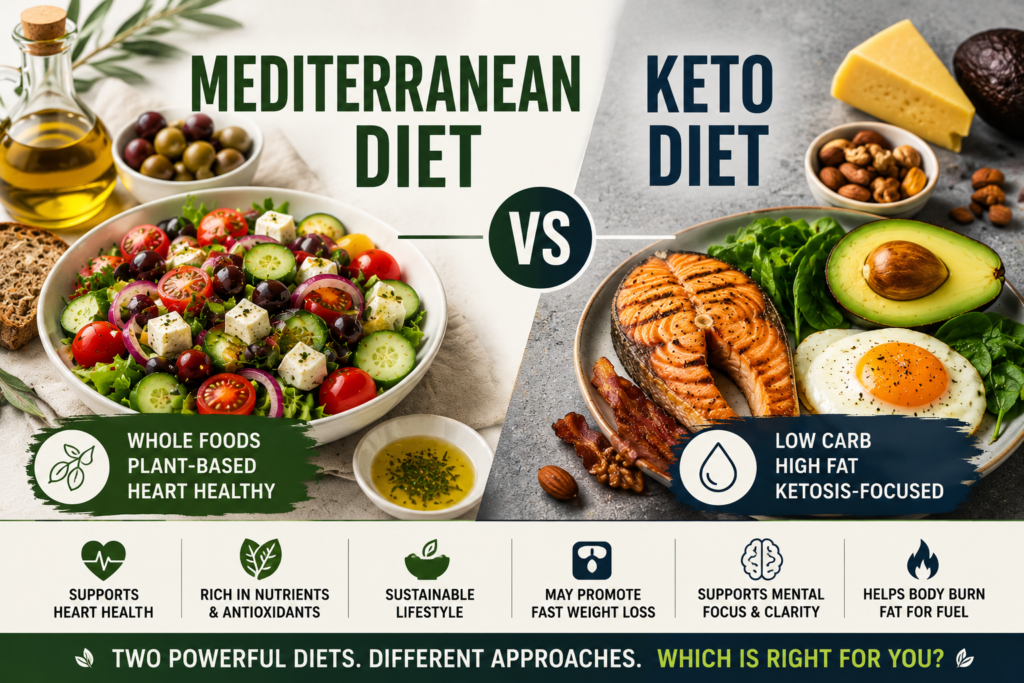
Mediterranean vs Keto for Body Transformation
Both diets work for fat loss. They differ in sustainability and how they make you feel.
| Factor | Mediterranean Diet | Keto Diet |
| Carbs | Moderate to high | Very low |
| Fat | Moderate (healthy fats) | Very high (~66%) |
| Best for | Long-term, sustainable results | Fast initial weight loss |
| Training fuel | Strong (carbs power workouts) | Can feel flat early on |
| Heart health | Lowers LDL cholesterol | May raise LDL cholesterol |
| Sustainability | High—flexible and varied | Lower—restrictive |
Stanford Medicine research found both diets produced similar weight loss and blood sugar control, but LDL cholesterol dropped on the Mediterranean diet and rose on keto. For most men chasing an athletic body, the Mediterranean approach wins on sustainability and training performance. Choose keto only if you respond well to it and don’t mind the restriction. For a side-by-side breakdown, read our Mediterranean vs keto comparison.
Summary: Nutrition is the biggest lever in any body transformation. Eat in a calorie deficit to lose fat, hit 0.7–1g of protein per pound of body weight, and build meals around whole foods. The Mediterranean diet beats keto for most men due to better sustainability and training fuel.
Step 3 — The Athletic Training Blueprint
This is where the body gets built. Your training has one job: stimulate muscle and build strength. Do that consistently, and your physique follows.
Why Strength Training Comes First
Strength training builds the muscle that defines an athletic body.
Cardio burns calories. Strength training shapes you. Without muscle underneath, losing fat just leaves you smaller, not athletic. Lifting weights is what creates the broad shoulders, defined arms, and tapered waist that make a physique look athletic. Strength comes first. Everything else supports it.
Best Exercises for Men
Master a handful of compound lifts. These work multiple muscles at once and deliver the most results for your time.
- Squats — build legs, glutes, and core strength
- Deadlifts — train the entire posterior chain, from hamstrings to back
- Pull-Ups — build a wide, strong back and powerful arms
- Bench Press — develop chest, shoulders, and triceps
- Overhead Press — build strong, capped shoulders
- Rows — thicken the back and balance out pressing work
Six movements. That’s the core of an athletic body. Get strong at these and you’ll rarely need anything fancier.
Beginner Weekly Training Plan
Three full-body sessions a week is plenty for a beginner. Here’s a simple, effective split.
| Day | Focus | Key Lifts |
| Monday | Full Body A | Squat, Bench Press, Row |
| Tuesday | Rest or Walk | Light cardio |
| Wednesday | Full Body B | Deadlift, Overhead Press, Pull-Up |
| Thursday | Rest or Walk | Light cardio |
| Friday | Full Body C | Squat, Bench Press, Row |
| Weekend | Rest / Active recovery | Walking, mobility |
Three lifts per session, 3–4 sets of 5–10 reps each. Simple, repeatable, effective.
Progressive Overload Explained
Progressive overload means gradually doing more over time. It’s the single most important training principle.
Your muscles adapt to stress. To keep growing, you must keep increasing the challenge—more weight, more reps, or more sets. If you lift the same weight for the same reps forever, your body has no reason to change. Always be pushing the number up, even slightly.
When to Increase Weight
Add weight when you hit the top of your rep range with good form.
A simple rule: if your program calls for 5–10 reps and you complete 10 clean reps on every set, add weight next session. Increase by the smallest available jump—usually 2.5 to 5 pounds. Small, steady increases add up to massive gains over a year.
Common Gym Mistakes
Avoid these and you’ll out-progress most men in the gym.
- Ego lifting — using too much weight with sloppy form invites injury and limits growth.
- Skipping legs — half a physique isn’t athletic. Train your lower body.
- No tracking — if you don’t log your lifts, you can’t apply progressive overload.
- Too much, too soon — six days a week of intense lifting burns out beginners. Start with three.
- Chasing soreness — soreness isn’t a measure of a good workout. Progress is.
Step 4 — Cardio Without Losing Muscle
Cardio supports fat loss and health. Done wrong, it eats your muscle. Done right, it complements your training. Here’s how to use each type.
Walking
Walking is the most underrated fat-loss tool there is.
It burns calories, lowers stress, and barely touches your recovery. Aim for 8,000–10,000 steps a day. It’s low-impact, sustainable, and you can do it anywhere. For most men, walking does more for fat loss than any high-intensity session.
Zone 2 Training
Zone 2 is steady cardio at a pace where you can still hold a conversation.
This trains your body to burn fat as fuel and builds your aerobic base without crushing recovery. Think a brisk incline walk, easy cycling, or a light jog for 30–45 minutes. It’s low-stress, which means it won’t interfere with your lifting or eat into your muscle.
HIIT
High-intensity interval training burns a lot in a short time. Use it sparingly.
HIIT alternates hard bursts with rest. Research published in the NIH found it’s especially effective for fat oxidation and muscle retention in men aged 18–30, and it gets results in less time. But it’s taxing. Two sessions a week is plenty. More than that and it competes with your strength training for recovery.
| Cardio Type | Best For | Frequency | Muscle Impact |
| Walking | Daily fat loss, low stress | Daily | None—safe |
| Zone 2 | Aerobic base, fat fuel | 2–4x/week | Minimal |
| HIIT | Fast fat burn, time-saving | 1–2x/week | Risk if overdone |
Step 5 — Recovery Is Where Men Are Built
You don’t grow in the gym. You grow when you recover from it. Skimp on recovery and your training is wasted effort.
Sleep and Testosterone
Sleep is the most powerful recovery tool you have. It also drives testosterone.
Poor sleep tanks your testosterone, spikes your appetite, and slows muscle repair. Aim for 7–9 hours a night. If you fix only one recovery habit, fix this one. No supplement comes close to a full night’s sleep.
Stress Management
Chronic stress raises cortisol, which works against muscle and fat loss.
When stress stays high, your body holds onto fat—especially around the midsection—and struggles to recover. Manage it actively. Walk, train, breathe, and protect your downtime. Stress isn’t just a mood problem; it’s a physique problem.
Rest Days
Rest days are when your body rebuilds. They’re part of the program, not a break from it.
Take at least two full rest days a week as a beginner. Use them for light walking or mobility, not more lifting. More training isn’t always more progress. Sometimes the best thing you can do for your body is leave it alone.
Recovery Warning Signs
Your body sends signals when it’s under-recovered. Learn to read them.
Watch for persistent fatigue, stalled strength, poor sleep, irritability, and a flat mood. These mean you’re doing too much and recovering too little. One of the most effective tools for managing stress and improving recovery is mindfulness—the NIH reports that mindfulness lowers blood pressure, reduces anxiety, and improves sleep. Build a few mindfulness habits into your routine to keep your recovery on track.
Body Transformation Timeline
Change follows a predictable arc. Knowing what to expect keeps you patient when results feel slow.
- First 30 Days — Habits form. You’ll feel stronger and more energetic. Visible change is minimal, but the foundation is being laid.
- First 90 Days — Real change shows. Clothes fit differently, lifts climb, and others start to notice. This is the make-or-break window most men quit before reaching.
- 6 Months — Your transformation is undeniable. Muscle is visible, fat is noticeably down, and your strength has roughly doubled on key lifts.
- 12 Months — You’ve built an athletic body. What started as a goal is now your identity.
| Timeframe | What Happens | What to Focus On |
| 0–30 days | Habits form, energy rises | Consistency over intensity |
| 30–90 days | Visible change begins | Progressive overload, protein |
| 3–6 months | Clear physique changes | Stay the course, refine diet |
| 6–12 months | Athletic body built | Set new goals, maintain |
Supplements That Actually Help
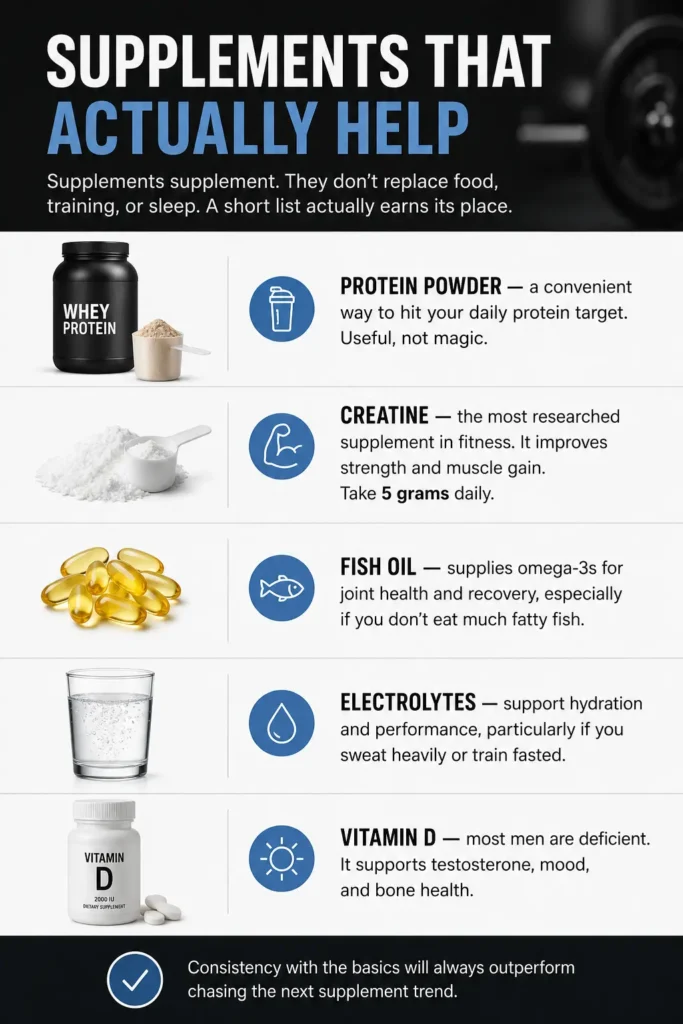
Supplements supplement. They don’t replace food, training, or sleep. A short list actually earns its place.
- Protein Powder — a convenient way to hit your daily protein target. Useful, not magic.
- Creatine — the most researched supplement in fitness. It improves strength and muscle gain. Take 5 grams daily.
- Fish Oil — supplies omega-3s for joint health and recovery, especially if you don’t eat much fatty fish.
- Electrolytes — support hydration and performance, particularly if you sweat heavily or train fasted.
- Vitamin D — most men are deficient. It supports testosterone, mood, and bone health.
Supplements to Avoid
Skip anything that promises fast fat loss or instant muscle. Fat burners, testosterone “boosters,” detox products, and miracle pills are mostly marketing. They drain your wallet and deliver nothing the basics don’t already provide. Save your money and spend it on good food.
The Stoic Mindset of Physical Transformation
The body is built by the mind. Every man who transformed himself first won the battle in his head. This is the part no program teaches—and the part that matters most.
Discipline Over Motivation
Motivation comes and goes. Discipline shows up regardless.
Discipline is doing what needs doing whether or not you feel like it. It’s the bridge between the man you are and the man you want to be. Build it like a muscle—one kept promise at a time.
Also Read – Stoic Discipline & Mental Strength: The Complete Guide to Building Unshakable Resilience
Showing Up On Bad Days
Anyone can train when they feel great. Champions train when they don’t.
The workouts you do when you’re tired, busy, or unmotivated are the ones that build real character. They prove to yourself that your word means something. Those days, more than any other, are where transformation happens.
Delayed Gratification
The man who can wait wins.
Skip the immediate comfort—the extra slice, the skipped session, the late night that wrecks your sleep. Every time you choose the harder thing, you’re making a deposit. The body you want is built from those deposits, compounded over months and years. Short-term discomfort is the price. A stronger, leaner, more capable version of yourself is the return.
Physical transformation is the training ground. It teaches you that effort produces results, that discomfort is temporary, and that the man in the mirror is something you can change. Those lessons don’t stay in the gym. They carry into every corner of your life.
“The body follows where the mind leads.” Build the mind first. The body will follow.
Frequently Asked Questions
How long does it take to build an athletic body?
Most men see visible change within 8–12 weeks and a significant physique transformation within 6–12 months. A full athletic build—lean, strong, and proportional—is realistic within one to two years of consistent training and nutrition.
Can men build muscle after 40?
Yes. Testosterone declines with age, but muscle growth remains entirely possible. Men over 40 need to prioritize protein intake, manage recovery more carefully, and train consistently. Progress is slower, but the fundamentals don’t change.
Is cardio necessary for fat loss?
No. Fat loss is driven by a calorie deficit, not cardio. Cardio helps burn additional calories and supports heart health, but you can lose fat through diet alone. Walking is the most practical starting point for most men.
How much protein should men eat daily?
Aim for 0.7 to 1 gram of protein per pound of body weight. A 180-pound man needs roughly 130–180 grams per day. Spread it across meals and prioritize it at breakfast and post-workout.
Can I transform my body without a gym?
Yes. Bodyweight training—push-ups, pull-ups, squats, lunges, and dips—builds real muscle if you apply progressive overload. A pair of adjustable dumbbells and a pull-up bar covers most of what you need. The gym speeds things up; it’s not a requirement.
What is the fastest way to lose belly fat?
A calorie deficit is the only direct path. Combine it with strength training to preserve muscle, high protein to stay full, and daily walking to increase calorie burn. There is no exercise or food that targets belly fat specifically. Reduce overall body fat and your midsection follows.
How many calories should men eat?
Multiply your body weight in pounds by 14–16 to estimate your maintenance calories. Subtract 300–500 to lose fat. Add 200–300 to build muscle. Adjust every few weeks based on actual results.
What body fat percentage is athletic?
Most men look and perform at their best between 10–15% body fat. Below 10% is lean enough to see full muscle definition. Above 20% and the athletic look fades. The 10–15% range is the practical target for most men.
What are the best exercises for beginners?
Start with the six compound lifts: squat, deadlift, bench press, overhead press, pull-up, and row. These build full-body strength and muscle efficiently. Master form before chasing heavy weights.
Can I gain muscle while losing fat?
Yes—this is body recomposition. It works best for beginners, men returning after a break, and those with higher body fat. Eat at or near maintenance, hit your protein target, and train with progressive overload. Results come slower than a dedicated bulk or cut, but you improve on both fronts at once.
Do I need supplements to transform my body?
No. Supplements are optional extras, not requirements. Creatine, protein powder, vitamin D, and fish oil have the strongest evidence. Everything else is largely marketing. Food, training, sleep, and consistency do the real work.
How important is sleep for body transformation?
Sleep is where your body actually rebuilds. Poor sleep lowers testosterone, raises cortisol, slows recovery, and increases hunger. Consistently getting 7–9 hours a night is one of the highest-return habits in your entire program.
What should I eat before a workout?
A meal with moderate carbohydrates and protein 60–90 minutes before training works well for most men. A banana and a protein shake, or rice with chicken, covers the bases. Avoid large amounts of fat or fiber close to training—they slow digestion.
How do I stay consistent when motivation drops?
Build structure, not willpower. Schedule your workouts like appointments. Start small on low-motivation days—commit to just ten minutes. Lower the barrier to entry and rely on your system, not your mood. Motivation is a bonus. Discipline is the engine.
What’s the single most important change I can make right now?
Start training consistently and hit your protein target. If you do only two things—lift weights three times a week and eat enough protein—you will build a better body. Everything else is refinement.
Final Thoughts
A better body won’t solve every problem in your life.
But it will teach you something valuable: you are capable of more than you think.
Strength isn’t built in a day. It’s built one workout, one meal, one choice at a time. The men who transform themselves aren’t the most gifted or the most motivated. They’re the ones who kept showing up when it would have been easier to stop.
Start where you are. Use what you have. Keep showing up.
The athletic body you want is simply the result of hundreds of ordinary days done right.

Abhishek Negi is the founder and content creator behind Peak Mode Life. He writes about fitness, nutrition, wellness, relationships, and healthy living. His goal is to simplify health information into practical, actionable advice that helps readers build sustainable habits and improve their overall quality of life.