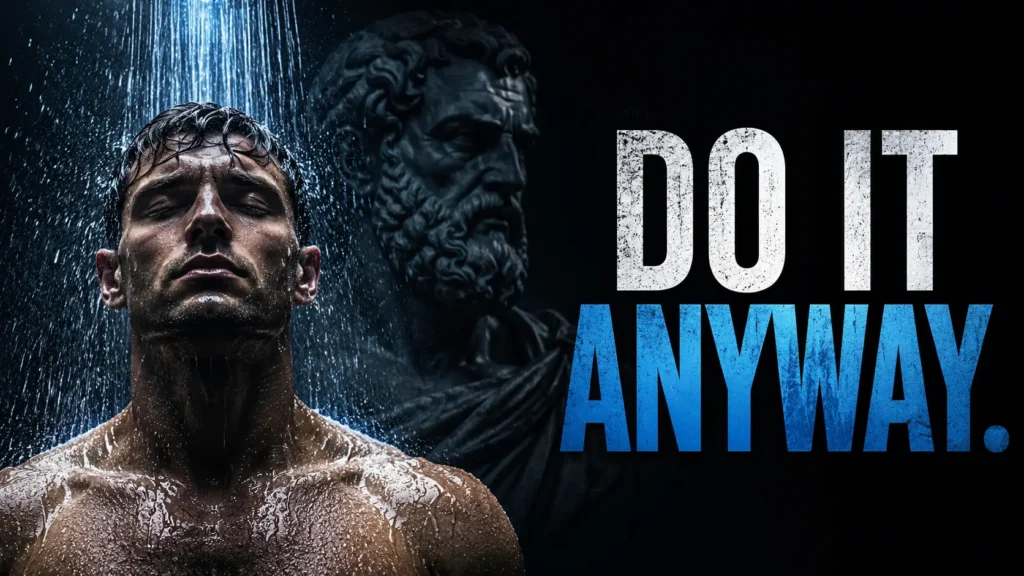
You turn the shower handle toward cold. Before the water even hits you, your body has already started arguing with you. Your breathing changes. Your shoulders tense. Your mind starts negotiating — maybe tomorrow, maybe just ten seconds, maybe this is a bad idea altogether.
Then the water hits, and for a few seconds, none of that negotiating matters. There’s only the cold, and how you choose to respond to it.
That’s the real point of a cold shower. Not the temperature. Not the “shock.” The goal isn’t to enjoy the cold — it’s to practice choosing your response while experiencing discomfort.
Cold exposure has become one of the most talked-about tools in the self-improvement world, and it’s often sold as a shortcut to discipline, focus, and even happiness. Supporters claim it rewires your brain, floods you with dopamine, and turns you into a calmer, tougher version of yourself. Critics call it a fad wrapped in pseudoscience.
The truth sits in between — and it’s more interesting than either extreme.
By the end of this guide, you’ll understand what the research actually shows, how cold exposure affects your nervous system, what claims are overstated, and how to build a safe, sustainable cold-shower practice if you decide it’s worth trying.
Key Takeaways
- Cold exposure activates a genuine physiological stress response.
- Research shows promising but inconsistent psychological benefits.
- Cold showers shouldn’t be presented as a treatment for depression or anxiety.
- Norepinephrine is involved in the cold-response system, but popular dopamine claims are often overstated.
- Cold showers can serve as a controlled practice of discomfort tolerance and self-regulation.
- Beginners should start gradually rather than chasing extreme temperatures.
- Consistency and safety matter more than intensity.
- The goal isn’t to suffer more — it’s to become more capable of responding calmly to discomfort.
Quick Answer: Do Cold Showers Build Mental Toughness?
Cold showers may help develop some components of mental toughness — particularly tolerance of discomfort, perceived control, and self-efficacy. But direct evidence that cold showers independently “build mental toughness” is still limited.
Research on cold-water exposure suggests potential effects on perceived stress, mood, wellbeing, and resilience, but the studies vary considerably in quality, methodology, and what exactly they measured.
The strongest argument for cold showers isn’t that they transform your brain chemistry. It’s that they give you a repeatable, voluntary stressor — a small, controlled dose of discomfort you can practice staying calm inside of, on demand, every single day.
What Does Mental Toughness Actually Mean?
Most articles treat mental toughness like a vague slogan — “doing hard things,” “embracing the suck,” “no excuses.” That framing sounds motivating, but it doesn’t hold up to how psychologists and sports-performance researchers actually define the concept.
Mental toughness is better understood as a set of trainable psychological skills, not a personality trait you either have or don’t. Research from sport and performance psychology generally breaks it into four overlapping components.
The four components of mental toughness
1. Stress tolerance The ability to remain functional — to keep thinking clearly and acting deliberately — when pressure or discomfort increases.
2. Emotional regulation The ability to experience fear, frustration, or anxiety without automatically reacting to it. This is the gap between feeling something and acting on it.
3. Self-efficacy The internal belief of “I can handle this.” Self-efficacy isn’t confidence in general — it’s confidence built from specific evidence of having handled specific things before.
4. Persistence The ability to continue toward a goal despite discomfort, fatigue, or setbacks along the way.
Here’s where the cold shower connection becomes interesting — not because cold water magically installs these traits, but because it creates a small, safe arena to practice all four at once.
| Mental Toughness Component | What the Cold Shower Trains |
|---|---|
| Stress Tolerance | Staying calm during the initial cold shock |
| Emotional Regulation | Controlling your breathing and reaction |
| Self-Efficacy | Proving to yourself that you can tolerate discomfort |
| Persistence | Remaining in the shower despite the urge to escape |
To be clear: this table isn’t proof that cold showers cause mental toughness. It’s an explanation of why cold exposure is such an interesting behavioral tool for practicing it. In that sense, a cold shower belongs in the same category as other self-discipline techniques — tools that let you practice acting according to intention rather than immediate comfort, in a low-stakes setting before it counts somewhere else.
Why Cold Exposure Is Interesting for Mental Resilience
Modern life is engineered to remove discomfort. Climate control, food delivery, algorithmic entertainment — nearly everything around you is optimized to keep you comfortable at all times. That’s not inherently bad. But it also means most people rarely encounter manageable, voluntary discomfort anymore.
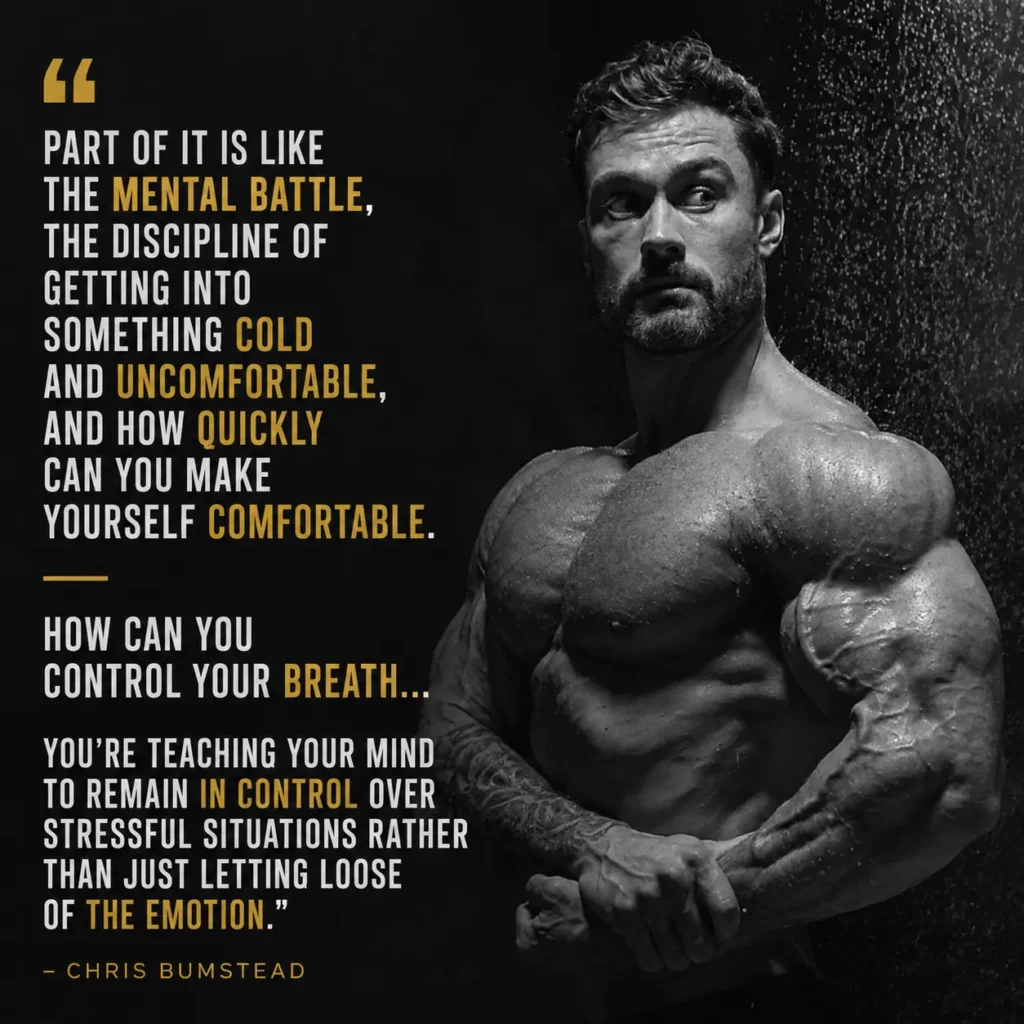
This is where cold exposure becomes philosophically useful, independent of any specific physiological claim. Comfort isn’t inherently bad. Discomfort isn’t inherently good. But deliberately experiencing manageable discomfort — on your own terms, at a time you choose — teaches you something that comfort never can: how you actually respond under pressure.
This is the core of cold exposure and mental resilience. Resilience isn’t the absence of stress. It’s the ability to remain functional while stress is present. A cold shower is a two-minute rehearsal for that exact skill.
What Does the Science Actually Say About Cold Showers?

This is where a lot of cold-exposure content falls apart — either by cherry-picking a single flashy statistic, or by dumping a wall of citations without explaining what they mean. Here’s a more honest approach: study, finding, meaning, and limitation, for each of the major reviews.
2025 systematic review: promising signals, but not a miracle
A 2025 systematic review by Cain and colleagues pooled data from 11 randomized controlled trials covering roughly 3,177 participants exposed to various forms of cold water. The findings were mixed and highly dependent on when researchers measured outcomes.
Immediately after exposure, and around the one-hour mark, participants tended to show an acute inflammatory response — a normal physiological reaction to a cold stressor. Reductions in perceived stress appeared more reliably around the 12-hour mark, but there was no consistent evidence of stress reduction immediately after exposure or at 24–48 hours later. Some evidence pointed to modest benefits for sleep and general quality of life, but mood outcomes weren’t consistently positive across the pooled studies.
What this means: Cold-water exposure may influence stress and wellbeing at certain time points, but the evidence doesn’t support treating cold showers as a universal mental-health intervention.
2026 systematic review: psychological benefits remain uncertain
A more recent systematic review by Schepanski and colleagues in 2026 examined 13 studies covering about 4,105 participants. It found modest signals of benefit for perceived stress, depressive symptoms, mood, and general wellbeing. Anxiety-related outcomes were less consistent, and confidence intervals across the pooled data were often wide — a sign of real uncertainty rather than a clear effect.
When the researchers restricted their analysis to only the most rigorously controlled studies, some of these effects weakened. Many of the included studies also carried a substantial risk of bias, whether from small sample sizes, lack of blinding, or inconsistent protocols.
Important conclusion: the evidence suggests potential — not proof. That distinction matters, and it’s worth holding onto for the rest of this article.
What About Cold Showers Specifically?
Here’s a distinction most cold-exposure content glosses over: a large share of the research on “cold water immersion” involves ice baths, cryotherapy chambers, or cold-water swimming — not the standard cold shower most people are picturing. Treating all of that evidence as interchangeable is misleading.
The 2016 cold-shower RCT
The most directly relevant study on household cold showers comes from Buijze and colleagues in 2016. Roughly 3,000 adults were randomized to take cold showers of 30, 60, or 90 seconds (following their normal warm shower) for 30 consecutive days, or to a control group with no cold exposure.
The results were more modest than viral headlines suggest. Participants in the cold-shower groups reported a 29% reduction in self-reported sickness absence from work — but there was no significant reduction in the actual number of sick days once someone did fall ill. There was a small improvement in the mental component of quality-of-life scores at the 30-day mark, but that effect wasn’t maintained by the 90-day follow-up.
Key insight: this study doesn’t prove that cold showers make people mentally tougher. What it does show is that short, simple cold showers are a practical intervention that researchers can study at scale — and that even a modest daily practice can produce measurable (if temporary) effects.
How Cold Showers Affect Your Brain and Body
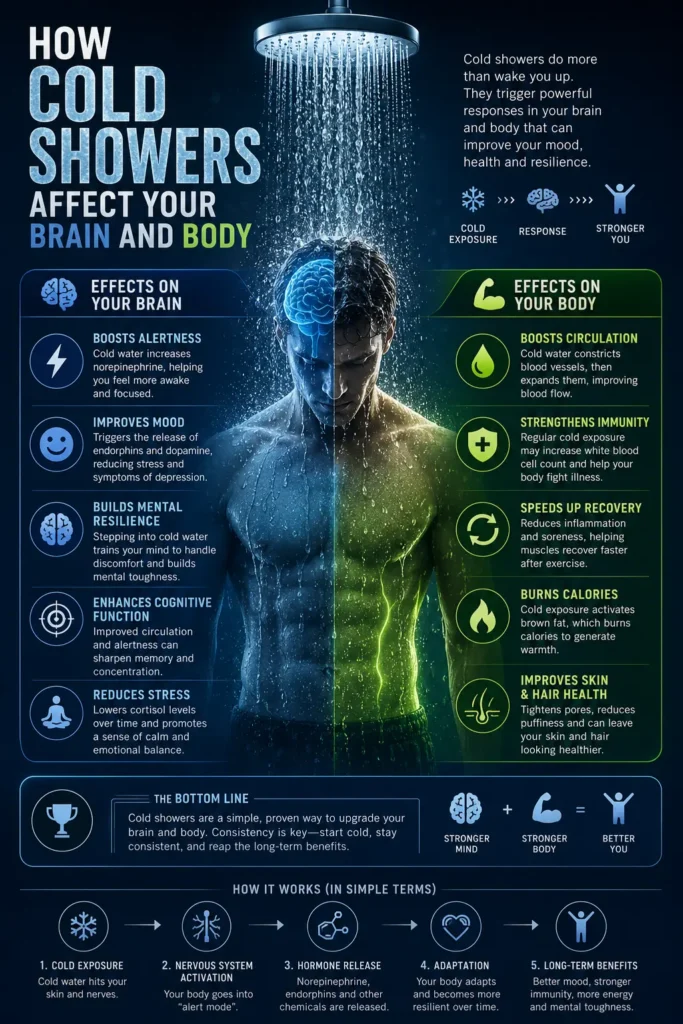
To understand why cold exposure feels like such an intense mental exercise, it helps to understand what’s actually happening physiologically.
1. Cold shock activates your stress response
The sequence goes roughly like this: cold hits your skin, sensory receptors fire, and your sympathetic nervous system activates — the same system responsible for your fight-or-flight response. Heart rate increases, breathing quickens, and blood pressure rises.
Your brain initially interprets sudden cold exposure as a genuine stressor, not a wellness ritual. That’s exactly what makes it useful as a training tool: you get high physiological arousal paired with the opportunity for conscious behavioral control. It’s stress you opted into, which means it’s stress you can practice managing.
2. Norepinephrine and alertness
Norepinephrine is a neurotransmitter and hormone tied to alertness, attention, arousal, and the body’s stress response. You’ll often see claims that cold showers spike norepinephrine by “200–300%.” That figure originates from specific cold-immersion research protocols, and the actual magnitude of the increase depends heavily on exposure method, water temperature, duration, and individual study design.
A more accurate way to put it: research on cold exposure has reported substantial increases in circulating norepinephrine, though the size of that increase varies considerably depending on how the cold was administered and measured. It’s real, but it isn’t a fixed, guaranteed multiplier you get from any two-minute cold shower.
3. What about dopamine?
This is one of the most overstated claims in the entire cold-exposure conversation, and it’s worth correcting directly.
Myth: “Cold showers give you a 250% dopamine increase that lasts for hours.”
Reality: that figure traces back to specific cold-immersion research and has been widely reinterpreted in ways the original data doesn’t fully support. It doesn’t establish that a typical household cold shower produces a specific, guaranteed dopamine increase in the brain.
A few things worth knowing: peripheral measurements of neurotransmitters aren’t the same as direct measurement of brain activity. Different exposure protocols (ice baths vs. cold showers, 30 seconds vs. 5 minutes, 60°F vs. 40°F) produce meaningfully different physiological responses. And direct evidence connecting these neurotransmitter changes to improved mental toughness — as opposed to short-term alertness — remains limited.
None of this means cold showers “don’t do anything.” It means the popular version of the claim has outrun the actual data.
The Real Mental-Toughness Mechanism: Voluntary Stress Training
Instead of claiming “cold showers make you stronger,” it’s more accurate — and more useful — to explain the behavioral loop that’s actually happening.
The Cold-Shower Mental Toughness Loop: Discomfort → automatic reaction → conscious breathing → staying present → completing the chosen action → increased self-efficacy
Here’s what each step looks like in practice:
Step 1 — Your body reacts. Cold shock produces an automatic physiological response. This part isn’t optional, and it isn’t a failure — it’s just biology.
Step 2 — Your mind wants escape. A single, loud thought shows up: get out. This is the moment most people either give in or turn toward the practice.
Step 3 — You don’t fight the sensation. Instead of tensing against the cold or mentally battling it, you observe it. This shift — from resistance to observation — is a core emotional-regulation skill.
Step 4 — You regulate your response. You slow your breathing. You consciously relax muscles that don’t need to be tense — your jaw, your shoulders, your fists.
Step 5 — You stay with the chosen task. This is where the actual psychological training happens. Not in the cold itself, but in choosing to remain present with it for a few more seconds than feels comfortable.
Step 6 — You build evidence about yourself. Instead of just telling yourself “I’m disciplined,” you generate proof: I was uncomfortable, and I remained in control. That sentence, repeated daily, is a far more compelling explanation for how cold exposure supports mental resilience than any neurotransmitter chart.
Cold Showers for Stress Relief: What Can You Realistically Expect?
It helps to separate the timeline into three honest categories.
Immediate effects: increased alertness, a strong (but brief) physiological arousal response, a perceived energy boost, and sometimes a temporary mood lift right after stepping out.
Later effects: some research suggests potential changes in perceived stress at certain later time points (as noted in the reviews above), though the effect isn’t consistent across all studies.
Long-term effects: the evidence isn’t strong enough to say that cold showers permanently reduce stress on their own. What’s more defensible is that they may function as one component of a broader stress-management routine — alongside sleep, exercise, meditation, breathwork, social connection, and professional support when needed.
What Cold Showers Cannot Do
This section matters more than almost any other part of this article, because it’s where a lot of cold-exposure content quietly loses its credibility.
| Claim | Evidence |
|---|---|
| Cure depression | ❌ Not established |
| Cure anxiety | ❌ Evidence inconsistent |
| Permanently increase dopamine | ❌ Overstated |
| Make you mentally tough automatically | ❌ Not established |
| Improve stress response | 🟡 Promising but limited |
| Increase alertness | 🟡 Plausible, short-term |
| Improve wellbeing | 🟡 Some evidence |
| Train tolerance of discomfort | 🟢 Strong behavioral rationale, though direct causal evidence is still limited |
Cold showers aren’t therapy
This deserves to be stated plainly: cold-water exposure should not replace evidence-based treatment for depression, anxiety, or other mental-health conditions. If you’re dealing with a diagnosed condition, a cold shower is not a substitute for working with a qualified professional — it can, at best, be one small piece of a much larger picture.
Cold Shower vs. Ice Bath for Mental Toughness
A common question: if cold exposure is the goal, why not just go straight to an ice bath?
| Factor | Cold Shower | Ice Bath |
|---|---|---|
| Accessibility | Very high | Moderate |
| Cost | Very low | Higher |
| Intensity | Low–moderate | Moderate–high |
| Setup | Easy | Requires equipment |
| Beginner friendly | Yes | Less so |
| Risk | Generally lower | Higher |
| Mental toughness potential | Good | Potentially higher discomfort |
| Necessity | No special equipment | No need for most beginners |
Bottom line: you don’t need an ice bath to practice voluntary discomfort. For most beginners, a cold shower is sufficient as a controlled, low-cost, low-risk form of exposure — and it’s something you can do every day without buying anything or scheduling anything.
How to Start Cold Showers Without Going Too Far
The biggest mistake people make with cold exposure is treating it like a competition. More cold, more time, and more suffering isn’t the goal — consistency is. If you already follow a disciplined morning routine, a short cold-shower finisher slots in easily as a simple behavioral cue — something concrete that kicks the day off with a small, deliberate act of control before anything else demands your attention. Here’s a beginner-friendly, four-week protocol.
The 4-Week Cold Shower Protocol for Beginners
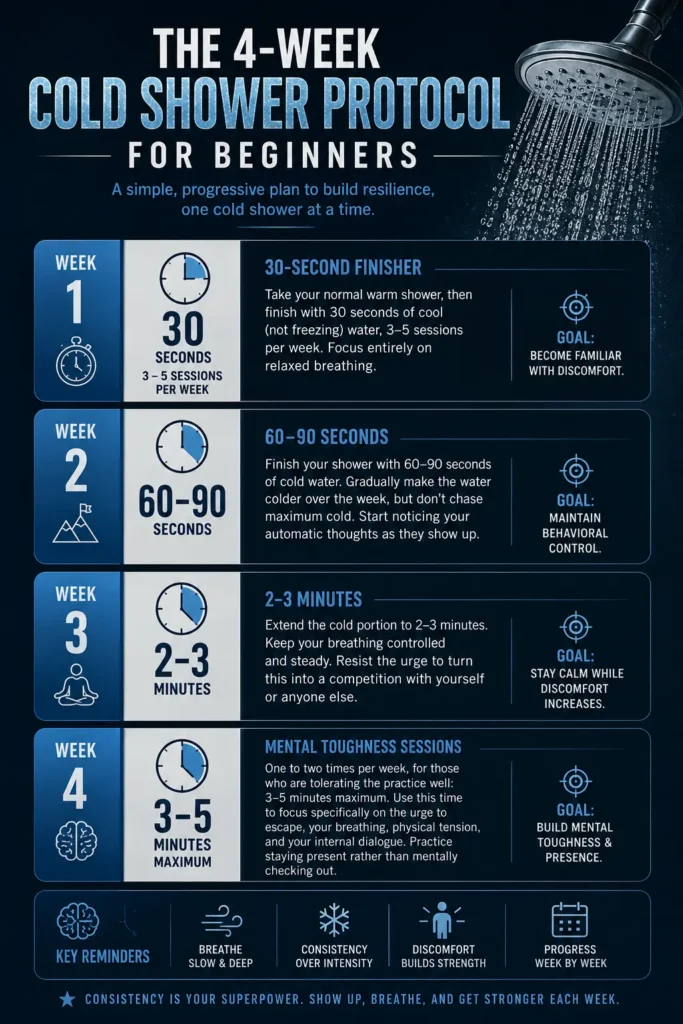
Week 1 — 30-second finisher Take your normal warm shower, then finish with 30 seconds of cool (not freezing) water, 3–5 sessions per week. Focus entirely on relaxed breathing. Goal: become familiar with discomfort.
Week 2 — 60–90 seconds Finish your shower with 60–90 seconds of cold water. Gradually make the water colder over the week, but don’t chase maximum cold. Start noticing your automatic thoughts as they show up. Goal: maintain behavioral control.
Week 3 — 2–3 minutes Extend the cold portion to 2–3 minutes. Keep your breathing controlled and steady. Resist the urge to turn this into a competition with yourself or anyone else. Goal: stay calm while discomfort increases.
Week 4 — Mental toughness sessions One to two times per week, for those who are tolerating the practice well: 3–5 minutes maximum. Use this time to focus specifically on the urge to escape, your breathing, physical tension, and your internal dialogue. Practice staying present rather than mentally checking out.
A useful mantra for this stage: discomfort is data, not danger.
That said — discomfort shouldn’t be treated as proof that everything is fine. If you develop symptoms that feel genuinely concerning (not just uncomfortable), stop and get out.
How to Breathe During a Cold Shower
Breathing is arguably more important than water temperature, and it deserves its own section.
Don’t try to “win” against the cold — you’re not fighting it, you’re working with it. Enter the water gradually rather than diving straight in. Expect an initial gasp response; this is normal and happens to nearly everyone. Focus on steady, controlled breathing rather than short, panicked breaths. Deliberately relax your shoulders, which tend to creep up toward your ears under cold stress. Avoid deliberately hyperventilating before or during the shower, which can increase dizziness risk. And exit immediately if you become dizzy, faint, confused, or otherwise unwell.
How to Know If Cold Showers Are Actually Helping You
Rather than relying on how you feel about the practice in the moment, run a simple 30-day personal experiment and track the numbers. Thirty days is also roughly the window where habit formation research suggests a new behavior starts to feel automatic rather than effortful — so the same stretch that gives you useful data is also the stretch where the practice tends to get easier to sustain.
| Metric | Before | After |
|---|---|---|
| Mood | ||
| Stress | ||
| Energy | ||
| Focus | ||
| Sleep Quality | ||
| Cold Tolerance |
The important caveat: don’t measure success by how cold you can tolerate, or how long you can stay in. Measure whether the practice is changing your behavior — your ability to stay composed under other, unrelated forms of discomfort in daily life.
Common Cold-Shower Mistakes
1. Going freezing immediately. More intensity doesn’t equal more benefit — it usually just equals more people quitting after day two.
2. Treating pain as progress. Mental toughness isn’t self-punishment. If the practice feels like punishment, something’s off.
3. Chasing dopamine. Turning cold showers into a neurochemical high-score chase misses the actual point of the practice.
4. Holding your breath. The objective is regulation, not endurance through suffering.
5. Ignoring warning signs. Stop the moment something feels medically wrong — dizziness, chest pain, numbness, or confusion are not things to push through.
6. Waiting for motivation. Cold showers don’t replace discipline. They’re a place to practice it, especially on the days you don’t feel like it.
Cold Water Therapy for Mental Health: Is It Safe?
For most healthy adults, brief cold showers carry a low risk profile. But cold exposure isn’t risk-free for everyone, and it’s worth being direct about that.
People with certain cardiovascular or other medical conditions should talk to a healthcare professional before starting a cold-exposure practice. Extra caution is warranted for anyone with cardiovascular disease, uncontrolled hypertension, arrhythmias, Raynaud’s phenomenon, cold urticaria, significant respiratory conditions, pregnancy, or other significant medical conditions.
The cold shock response itself can produce rapid breathing, dizziness, blood-pressure changes, fainting, or panic — particularly in people new to cold exposure or those with underlying health conditions. This isn’t meant to scare you away from trying it; it’s meant to make sure you approach it the way you’d approach any new form of physical stress — gradually, and with awareness of your own body.
Frequently Asked Questions
How long should a cold shower be for mental toughness? For beginners, even 30–60 seconds at the end of a normal shower is enough to start practicing the skill. There’s no evidence that longer automatically means better — consistency over weeks matters more than any single session’s length.
What temperature is best for cold showers? There’s no universally established “optimal” temperature. Beginners shouldn’t chase extremely low temperatures right away; a noticeably cool (not ice-cold) shower is a reasonable starting point, with gradual progression from there.
How often should you take cold showers? Most protocols suggest 3–5 sessions per week to start. Consistency matters more than frequency — a sustainable 4-day-a-week habit will outperform an intense but short-lived daily streak that burns out after two weeks.
Do cold showers increase dopamine? The often-cited figures (like a “250% increase”) come from specific research protocols and have been oversimplified in popular coverage. Cold exposure likely does influence dopamine and norepinephrine systems to some degree, but the magnitude and duration for a typical household cold shower isn’t well established.
Do cold showers increase norepinephrine? Research on cold exposure has reported meaningful increases in circulating norepinephrine, though the exact size of the effect depends on exposure method, temperature, and duration.
Can cold showers help with anxiety? Some research suggests possible benefits for perceived stress and general wellbeing, but evidence specifically for anxiety is inconsistent. Cold showers shouldn’t be treated as a replacement for anxiety treatment.
Can cold showers help depression? Similarly, some studies show promising signals for mood and depressive symptoms, but the evidence is not strong or consistent enough to recommend cold showers as a standalone treatment.
Are cold showers better than ice baths for mental toughness? Neither is objectively “better.” Cold showers are more accessible, cheaper, and lower-risk — making them a more practical starting point for most people. Ice baths offer more intensity but require equipment and carry higher risk.
Should you take a cold shower every day? Daily exposure isn’t required to see potential benefits. Several sessions per week, done consistently, is a reasonable and sustainable approach for most people.
What is the best cold shower protocol for beginners? The 4-week progressive protocol outlined above — starting with a 30-second finisher and building toward 2–5 minute sessions — is a practical, low-risk way to begin.
Final Verdict: Can Cold Showers Make You Mentally Tougher?
Here’s the honest, three-level answer.
What we know: cold exposure produces a genuine physiological stress response — increased heart rate, activated sympathetic nervous system, and a measurable release of stress-related hormones and neurotransmitters.
What appears promising: research suggests potential benefits for perceived stress, wellbeing, and some psychological outcomes, particularly around specific time windows after exposure.
What remains uncertain: whether cold showers independently produce lasting increases in mental toughness is not yet well established by the evidence.
The most defensible benefit of cold showers isn’t that cold water magically changes your brain. It’s that cold water gives you a controlled environment in which you can repeatedly practice regulating yourself while uncomfortable. This is where cold showers overlap with Stoic discipline and mental strength: the objective isn’t to eliminate discomfort, but to develop greater control over your response to it. The Stoic lesson was never “seek out pain” — it was “learn to govern your response.”
That governing — practiced two minutes at a time, most days of the week — is a much more honest description of what a cold shower can actually offer you.

Abhishek Negi is the founder and content creator behind Peak Mode Life. He writes about fitness, nutrition, wellness, relationships, and healthy living. His goal is to simplify health information into practical, actionable advice that helps readers build sustainable habits and improve their overall quality of life.