What it really means, the rules that actually work, and how to start — through a Stoic lens.
You do not need to remove dopamine from your brain. You need to regain control over where your attention goes.
That single distinction separates a useful dopamine detox from a gimmick. Search “dopamine detox” and you’ll find promises of brain resets, 24-hour silence retreats, and warnings that a normal Tuesday of texting friends and watching a show is somehow poisoning your reward system. Almost none of it is accurate, and very little of it is practical.
This guide corrects the misinformation and gives you something more useful: a behavioral reset, not a neurological cleanse. It combines what the evidence actually supports with a framework Stoic philosophers were using for self-command two thousand years before anyone had heard of a smartphone notification — the idea that freedom comes from creating space between an impulse and an action.
Quick Answers: Dopamine Detox at a Glance
What is a dopamine detox? A dopamine detox is a planned, temporary reduction in distracting or compulsive habits, aimed at helping you regain attention and make your behavior more intentional. It is not a way to lower or “flush out” dopamine itself.
Do dopamine detoxes work? They can help many people reduce distraction and become more aware of unhealthy habits. But the evidence for literally “resetting” dopamine levels or receptors through short-term abstinence is thin. The benefit comes from behavior change, not neurochemical flushing.
How long should a dopamine detox last? Beginners do better with a 24-hour experiment, one phone-free hour a day, or a 7-day targeted digital reset than with an open-ended, extreme abstinence period.
What are the main dopamine detox rules? Choose one problematic habit, set a measurable boundary, remove triggers, create friction, replace the behavior with something specific, and review your progress without self-punishment.
Do you have to avoid all pleasure? No. A healthy dopamine detox doesn’t require giving up food, exercise, music, friends, or every enjoyable activity. That approach is unsustainable and not what the practice is meant to be.
What is the real goal? Intentional behavior — not pleasure deprivation.
Key Takeaways
- A dopamine detox is not a literal medical detox and does not remove dopamine from your brain.
- The useful version targets compulsive, distracting, or overused habits — not pleasure itself.
- You do not need to give up every enjoyable activity to benefit.
- Start with one behavior that is costing you sleep, focus, relationships, or meaningful time.
- Removing cues and adding friction is often more effective than relying on willpower alone.
- Replace an unwanted habit with a specific alternative rather than leaving an empty gap.
- A lapse is information, not proof that you lack discipline.
- The Stoic goal isn’t suppressing every desire — it’s building the ability to choose your response.
What Is a Dopamine Detox?
The term “dopamine detox” took off as a shorthand for something people were genuinely struggling with: the sense that short-form video, constant notifications, and infinite-scroll apps had quietly taken over their attention. The label stuck because it sounded clinical and decisive. The problem is that “detox” implies you can flush a chemical out of your system through abstinence — and that’s not how dopamine, or the brain, works.
What people are actually trying to do is interrupt automatic, low-value behaviors and replace them with more deliberate ones.
A working definition: A dopamine detox is a short, intentional break from one or more high-distraction habits, aimed at regaining attention, reducing automatic behavior, and creating space for healthier routines.
What Activities Do People Usually Reduce?
- Endless short-video scrolling
- Constant social media checking
- Gaming binges
- Online gambling
- Impulsive snacking while consuming content
- Constant notification checking
- Reaching for the phone the moment boredom appears
- Switching between tasks instead of focusing
Not all enjoyable activities belong on this list, and that distinction matters. The problem isn’t pleasure — it’s behavior that repeatedly overrides your own priorities without your consent.
Can You Really “Reset” Dopamine?
This is where most dopamine detox content goes wrong, so it’s worth being precise.
Myth: You Can Flush Dopamine Out of Your Brain
Dopamine is a normal neurotransmitter involved in motivation, learning, movement, attention, and reward-related processes. It is present and active at all times — you cannot remove it, and you wouldn’t want to; dopamine depletion is associated with serious neurological conditions, not improved focus.
Myth: Dopamine Is Simply the “Pleasure Chemical”
It’s more accurate — and more useful — to think of dopamine as involved in motivation, anticipation, and learning what to expect from your environment, rather than pleasure alone. That’s part of why highly unpredictable rewards (an endless feed, a slot machine, a notification you can’t predict) are so compelling: the uncertainty itself is engaging.
Myth: One Day Without Pleasure “Resets” Your Brain
There is limited direct evidence that short abstinence periods produce a meaningful neurological reset. Whatever benefits people report likely come from something more mundane and more useful: reduced cue exposure, interrupted automatic routines, and intentional habit change.
What a Dopamine Detox Can Actually Do
- Help you notice automatic habits you weren’t consciously choosing
- Reduce interruptions to deep work or rest
- Identify the specific triggers behind a habit
- Build practice in delaying gratification
- Create room to rebuild healthier routines
- Free up time for activities that matter more to you
Building this kind of awareness is closely tied to what it means to stay disciplined over the long run — discipline isn’t a personality trait, it’s a set of practiced responses.
Do Dopamine Detoxes Work?
Direct answer: A targeted dopamine detox can help — if you treat it as a behavior-change experiment rather than a magical brain reset.
What May Actually Create the Benefits
- Reduced exposure to triggers
- Fewer interruptions
- Greater awareness of automatic behavior
- Increased friction around the unwanted habit
- A specific replacement routine
- Better environmental design
- Consistent reflection and repetition
None of these require a neurological explanation. They’re the same mechanisms behind most successful habit change.
Who May Find It Most Useful
- People who compulsively check their phones
- Students struggling with digital distraction
- Professionals constantly switching between apps and tabs
- Anyone using entertainment to avoid difficult tasks
- People trying to become more intentional with their time
What It Will Not Do
A dopamine detox is not a treatment or cure for ADHD, depression, anxiety, addiction, eating disorders, or other mental health conditions. If any of these are part of what you’re dealing with, a self-directed habit experiment is not a substitute for qualified care — more on that below.
Why Are High-Stimulation Habits So Hard to Stop?
Most compulsive digital habits follow a simple, well-documented loop.
The Cue → Routine → Reward Loop
1. Cue — A notification, boredom, stress, loneliness, fatigue, a difficult work task, or simply seeing your phone nearby.
2. Routine — The automatic action: scroll, check messages, watch another video, eat, game, browse.
3. Short-term reward — Novelty, relief, entertainment, escape, social feedback.
4. Repetition — Repeated behavior in similar situations becomes increasingly automatic, requiring less and less conscious decision-making each time.
The practical takeaway: the goal isn’t to destroy your reward system — it’s to interrupt the automatic loop at one of its weakest points.
This pattern is also behind a lot of what looks like procrastination. If you’ve ever wondered why you reach for distraction instead of starting the hard thing, it’s worth reading about how to stop being lazy as an environment and habit problem rather than a character flaw.
Dopamine Detox Benefits: What Can Beginners Realistically Expect?
It’s worth being honest about scale here, because exaggerated promises are exactly what makes this topic hard to trust.
Realistic benefits:
- Greater awareness of your own screen-time patterns
- Fewer unnecessary interruptions during the day
- More tolerance for boredom without immediately reaching for a distraction
- A stronger ability to delay an impulse
- More time available for reading, work, exercise, or relationships
- Better recognition of your own emotional triggers
- A stronger overall sense of intentionality
What you should not expect:
- Instant peak productivity
- Permanent, effortless motivation
- A “magical” brain reset
- Never feeling an urge again
- A cure for a serious behavioral or mental health condition
| What the evidence supports | What remains unproven |
|---|---|
| Reducing cue exposure lowers automatic triggering of habits | That abstinence “resets” dopamine receptors |
| Environmental design (friction, removing triggers) changes behavior | That a single day of restriction has lasting neurological effects |
| Replacement routines help prevent relapse into old habits | That dopamine itself can be “detoxed” from the body |
| Self-monitoring and reflection improve behavior change outcomes | That extreme sensory deprivation is necessary or beneficial for most people |
How to Do a Dopamine Detox for Beginners
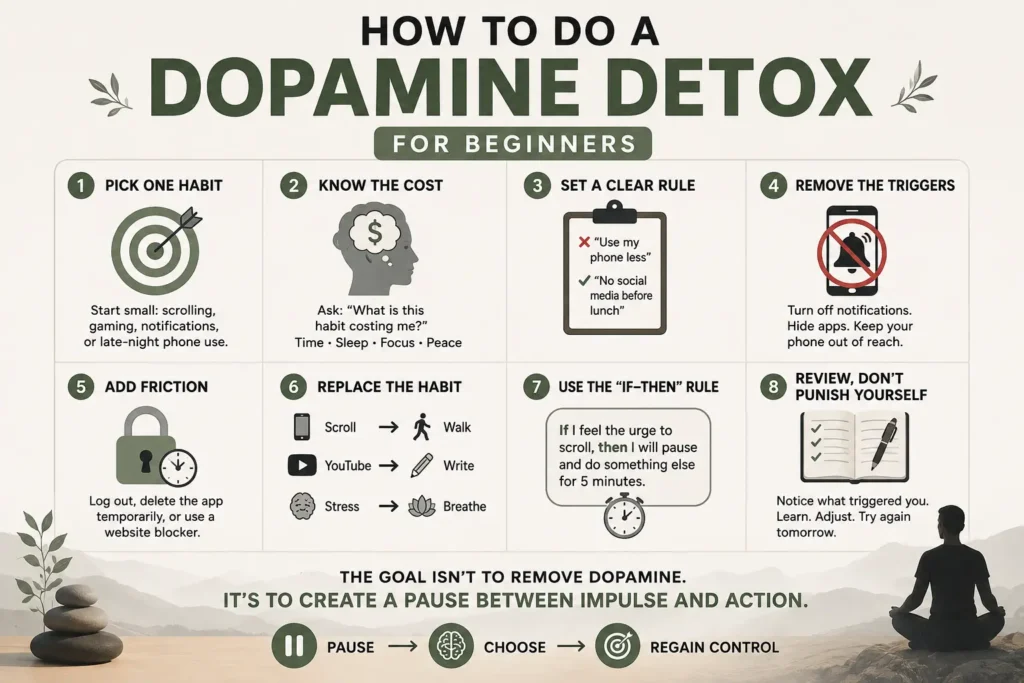
This is the practical core of the guide — a repeatable eight-step system rather than a single 24-hour stunt.
Step 1: Choose One Behavior
Don’t try to eliminate every pleasure at once. Pick one specific target:
- No short-form videos after 10 p.m.
- No social media before lunch
- No phone in the bedroom
- No gaming before essential work is done
- No unnecessary email checking during deep work
Key principle: start narrow. A specific behavior is far easier to change than your entire lifestyle, and success with one target builds the confidence to take on the next.
Step 2: Identify What the Habit Costs You
Use this reflection prompt honestly:
“When I repeatedly do this behavior, it costs me ______.”
Common answers: sleep, concentration, work quality, exercise, relationships, peace of mind, time, confidence.
This reframes the problem. Instead of “I am weak,” the honest statement becomes “this pattern is no longer serving my priorities.” That shift matters — shame rarely produces lasting change, but clarity about cost does.
Step 3: Create a Clear Boundary
A vague intention won’t survive contact with a boring afternoon.
Weak boundary: “I will use my phone less.” Strong boundary: “I will keep social media apps off my phone for seven days.”
Other examples: a 24-hour experiment, one phone-free hour daily, social media only once for 20 minutes, a 7-day phone-outside-the-bedroom rule, or no selected apps before completing the day’s priority task.
Step 4: Remove the Cues
Environment usually matters more than motivation. You are not going to out-willpower a phone sitting face-up on your desk indefinitely.
- Turn off non-essential notifications
- Remove addictive apps from your home screen
- Log out after each session
- Use website blockers during focused work
- Keep the phone outside the bedroom
- Place the device physically out of reach
- Keep a replacement activity visible and ready
Reducing unnecessary decisions like this is also a core reason structured routines work — it’s worth looking at how a daily schedule of successful people removes friction before the day even starts.
Step 5: Create Friction
Make the unwanted action slightly harder to perform. Small amounts of friction disproportionately reduce automatic behavior.
- Delete the app temporarily
- Remove saved passwords/auto-login
- Use a blocker
- Keep the phone in another room
- Require a short wait before opening a distracting app
Stoic interpretation: the Stoic doesn’t wait for temptation to disappear. They prepare their environment and rehearse their response before temptation arrives — a practice closely related to Stoic Discipline.
Step 6: Replace, Don’t Just Remove
An empty habit slot tends to get filled by the original behavior. Give yourself a specific, ready alternative.
| Trigger | Old Automatic Habit | New Response |
|---|---|---|
| Boredom | Scroll social media | Take a five-minute walk |
| Work resistance | Open YouTube | Write one imperfect sentence |
| Evening restlessness | Endless scrolling | Read fiction or journal |
| Stress | Constant checking | Breathing or stretching |
| Loneliness | Passive browsing | Call or message someone intentionally |
Step 7: Use an If–Then Plan
This is one of the most well-supported tools in behavior change research — a simple implementation intention.
Formula: If [specific situation happens], then I will [specific response].
Example: “If I feel the urge to open social media while working, then I will stand up, drink water, and work for five more minutes before deciding.”
The goal is not to eliminate urges — urges are normal and will keep showing up. The goal is to create a pause, and the pause gives conscious choice a chance to re-enter the picture.
Step 8: Review Without Self-Punishment
End each day with four honest questions:
- What triggered the urge?
- What did I do?
- What helped me resist or redirect it?
- What will I change tomorrow?
This kind of nightly review is the same practice behind Daily Stoic journaling — a short, honest accounting of the day rather than a moral scorecard.
Dopamine Detox Rules for Beginners
The 10 Practical Dopamine Detox Rules
- Do not try to eliminate dopamine — that’s not the goal and it isn’t possible.
- Choose one behavior to change first.
- Set measurable boundaries, not vague intentions.
- Do not turn the detox into extreme deprivation.
- Remove or reduce obvious triggers.
- Create friction around the unwanted habit.
- Replace the habit with a specific action.
- Expect urges instead of being surprised by them.
- Treat lapses as data, not failure.
- Seek professional support when the behavior is seriously affecting your life.
Important Rule: Do Not Restrict Food as a Default Detox Method
Some versions of “dopamine fasting” online recommend skipping meals as part of the challenge. This is not necessary, not well-supported, and potentially harmful — particularly for anyone with a history of disordered eating. Food restriction should never be treated as a standard or required part of a dopamine detox.
Your 7-Day Dopamine Detox Action Guide
Think of this as a structured, one-week experiment in digital self-command — not an extreme challenge.
| Day | Focus | Action |
|---|---|---|
| Day 1 | Observe | Track when, where, and why the habit occurs |
| Day 2 | Reduce Cues | Disable unnecessary notifications |
| Day 3 | Create Friction | Log out of apps or set up a blocker |
| Day 4 | Add Replacement | Choose one 5–10 minute alternative activity |
| Day 5 | Practice Delay | Wait 10 minutes before acting on an urge |
| Day 6 | Protect Attention | Complete one 60-minute distraction-free block |
| Day 7 | Reflect | Keep what worked, redesign what didn’t |
Daily Tracking Template
Use this each day of the experiment:
- Trigger:
- Urge intensity (1–10):
- What I did:
- Replacement action:
- What I learned:
What Can You Do During a Dopamine Detox?
A dopamine detox is not about sitting silently in an empty room. That misconception is exactly what makes the practice sound miserable and unsustainable.
Recommended activities:
- Walking
- Reading
- Journaling
- Exercise
- Deep, focused work
- Cooking
- Meaningful conversation
- Creative work
- Meditation
- Time outdoors
- Learning a new skill
- Sleep and recovery
A dopamine detox is not about making life empty — it’s about becoming more selective about how you spend your attention. Some people also use structured, voluntary discomfort — like cold water therapy for mental health — as part of a broader practice in choosing discomfort deliberately, rather than avoiding it automatically. It’s not a required step, and it’s not a cure for anything; it’s simply one more optional tool for practicing the pause between impulse and reaction.
Common Dopamine Detox Mistakes
Mistake 1: Trying to avoid every pleasure. Extreme deprivation is unsustainable and usually backfires within days.
Mistake 2: Believing you are “resetting” your brain. This misunderstanding sets you up for disappointment when nothing measurable “resets.”
Mistake 3: Relying entirely on willpower. Willpower is a limited, fluctuating resource — environmental design does more of the work.
Mistake 4: Removing a habit without replacing it. An empty slot tends to get refilled by the original behavior.
Mistake 5: Turning one lapse into total failure. From a Stoic perspective, a mistake is simply material for reflection, not evidence of who you are.
Mistake 6: Using shame as motivation. Moralizing distraction or compulsive behavior rarely produces lasting change and often makes the underlying pattern worse.
Mistake 7: Using a dopamine detox as a substitute for professional care. This especially matters for addiction, severe distress, or eating-related issues — see below.
When Should You Seek Professional Help?
A self-directed habit experiment is a useful tool for everyday distraction, but it is not a substitute for qualified support. Consider reaching out to a doctor or mental health professional if you experience:
- Loss of control over gambling, gaming, substances, or another harmful behavior
- Serious consequences but a repeated inability to stop
- Withdrawal from work, school, relationships, or self-care
- Severe anxiety or depression
- Thoughts of self-harm or suicide
- A history of disordered eating, where restrictive challenges of any kind could be harmful
If a compulsive pattern around sexual content specifically is something you’re trying to address, that’s a more targeted conversation than a general dopamine detox — resources like quit porn are built for that specific habit and its particular triggers.
If you are currently in crisis or having thoughts of suicide, please reach out to a crisis line or emergency services in your area rather than relying on a self-help article.
The Stoic Approach to Dopamine Detox and Self-Control
This is where the practical system above connects to something older and more durable than a seven-day challenge.
1. The Dichotomy of Control
You cannot control every notification, every algorithm, every advertisement, or every impulse that arises in your mind. What you can influence is your environment, your preparation, your response, and the very next action you take. This distinction sits at the center of Marcus Aurelius’s teachings — the idea that peace comes not from controlling the world, but from controlling your judgment about it.
2. Temperance, Not Deprivation
Stoicism is often mistaken for emotional suppression or the rejection of all enjoyment. It isn’t. The aim is measured use.
Deprivation says: “I must never enjoy this.” Temperance says: “I decide when and how much of this serves my life.”
That difference is the entire philosophy behind a sustainable dopamine detox.
3. Create Space Between Impulse and Action
The modern automatic response to a notification is: see → react.
The Stoic practice is: see → pause → judge → choose.
That single extra step — the pause — may be the most useful behavioral framework in this entire guide. It’s not about resisting every urge forever. It’s about making sure the urge doesn’t get to make the decision for you.
4. Voluntary Discomfort Builds Confidence
Leaving the phone behind during a walk. Sitting with boredom for ten minutes without reaching for a distraction. Finishing one difficult task before allowing entertainment. Delaying an impulse without panicking.
The lesson isn’t suffering for its own sake. The lesson is this: an urge can be uncomfortable without being an order you must obey.

How to Make the Results Last After Your Dopamine Detox
A seven-day experiment is only useful if something changes on day eight.
Keep the habits that worked. Don’t automatically slide back into every old pattern the moment the “official” detox ends.
Build permanent friction. Keep the phone outside the bedroom. Keep notifications limited. Keep social media off the home screen, even after the challenge is over.
Schedule enjoyment intentionally. Deliberate recreation — a show you chose to watch, a game you set time aside for — is a fundamentally different experience than automatic, unplanned consumption.
Continue weekly reflection. Ask yourself regularly: What is consuming my attention? What is restoring me? What am I doing automatically? What do I want to choose more deliberately?
Frequently Asked Questions
What is a dopamine detox in simple words?
It’s a short, intentional break from one or more distracting or compulsive habits — like excessive scrolling or notification-checking — designed to help you regain focus and act more deliberately, rather than automatically.
How do you start a dopamine detox?
Pick one specific habit, identify what it’s costing you, set a measurable boundary (not a vague goal), remove the obvious triggers, and plan a specific replacement activity before you begin.
What are the dopamine detox rules?
Don’t try to eliminate dopamine itself, target one habit at a time, set measurable boundaries, avoid extreme deprivation, remove triggers, add friction, replace rather than just remove, expect urges, treat lapses as data, and seek professional help when needed.
How long should a dopamine detox last?
There’s no required length. A 24-hour experiment or a 7-day targeted reset tends to be more sustainable and more informative than an arbitrary, extreme duration.
Do dopamine detoxes work?
They can help reduce distraction and build awareness of automatic habits, but there’s limited evidence they “reset” dopamine at a biological level. The benefit is behavioral, not neurochemical.
What should I avoid during a dopamine detox?
Rather than avoiding all pleasure, focus on one problematic behavior at a time. Trying to eliminate everything enjoyable at once is a common reason these experiments fail.
Can I listen to music during a dopamine detox?
Yes. The goal is intentional behavior, not universal avoidance of pleasure. If music isn’t the compulsive habit you’re targeting, there’s no reason to give it up.
Can I exercise during a dopamine detox?
Yes — exercise doesn’t need to be avoided and is often one of the most useful replacement activities during the process.
Should I fast during a dopamine detox?
No. Food restriction is not a standard or necessary part of a dopamine detox and can be genuinely harmful, especially for anyone with a history of disordered eating.
What happens if I fail my dopamine detox?
A lapse is feedback, not proof of failure. Use it to identify what trigger caught you off guard, then adjust your boundary or friction and try again.
Summary: Dopamine Detox at a Glance
A dopamine detox doesn’t remove dopamine or magically reset your brain. The useful version is a short, intentional experiment in reducing one or more distracting or compulsive behaviors.
Start with one habit. Identify its cost. Create a measurable boundary. Remove triggers. Make the unwanted behavior harder to do. Replace it with a better response. Review your results without shame.
From a Stoic perspective, the goal isn’t to eliminate desire or pleasure — it’s to strengthen the pause between impulse and action.
The purpose is not to live with less dopamine. It is to live with more deliberate attention.
You Do Not Need More Willpower — You Need More Deliberate Choice
Choose one habit that is taking more from your life than it gives. Don’t promise to change forever. Run a seven-day experiment. Observe the trigger, pause before the routine, and practice choosing your next action.
That single pause — repeated daily — is the entire practice. Everything else in this guide is just structure to help you hold onto it.

Abhishek Negi is the founder and content creator behind Peak Mode Life. He writes about fitness, nutrition, wellness, relationships, and healthy living. His goal is to simplify health information into practical, actionable advice that helps readers build sustainable habits and improve their overall quality of life.