
I used to think I had a laziness problem.
For years, I’d wake up with a list of things I knew mattered — a report due, a workout I’d promised myself, an inbox I was avoiding like it owed me money — and I’d just… not do them. I’d scroll instead. I’d tell myself I’d “start after coffee,” and then it would be 2 PM and I’d have accomplished nothing except three cups of coffee and a mild sense of self-loathing.
I read the productivity books. I bought the planners. I tried the 5 AM wake-up thing for exactly four days. Nothing stuck, and every time it fell apart, I added it to the evidence file I was quietly building against myself: you’re just not a disciplined person.
Here’s what changed everything — and it wasn’t a hack, a habit tracker app, or a stronger cup of coffee. It was one uncomfortable realization: laziness was never the real problem. It was the symptom. And once I stopped treating the symptom and started redesigning the system underneath it, discipline stopped feeling like a fight.
This is that story, and the framework that came out of it — grounded in neuroscience, sharpened by Stoic philosophy, and tested on myself before I’d ever recommend it to you.
The Brutal Truth: You’re Probably Not Lazy
I want to say this plainly, because it took me embarrassingly long to accept it: laziness is rarely a character flaw. It’s usually your brain protecting you from something — fear, overwhelm, a task with no clear “why,” or a nervous system running on fumes.
When I actually got honest with myself about the mornings I couldn’t get out of bed to work, it was never that I didn’t want to succeed. It was one of these, almost every time:
Mental fatigue and burnout. When your cognitive tank is empty, even simple tasks feel like climbing a wall. I wasn’t avoiding the work — I was avoiding the cost of the work, because I had nothing left to pay it with.
Dopamine misalignment. Your brain is wired to chase what feels good right now, not what pays off in six months. If a task offers zero immediate reward, your brain quietly routes you toward whatever does — Instagram, YouTube, a snack, anything.
Executive dysfunction. This one surprised me. It’s not about willingness — it’s about the sheer difficulty of initiating. I wanted to start. I just couldn’t find the on-ramp. This shows up constantly for people managing ADHD, anxiety, or high-stress leadership roles where the mental load never really switches off.
Fear and perfectionism. Procrastination, I learned, is often just fear wearing a disguise. Fear of doing it badly. Fear of finishing and being judged. Sometimes, weirdly, fear of succeeding and what that would demand of me next.
Lack of clarity or purpose. Without a reason that actually moves me, my mind defaults to comfort every time. No compelling “why” means no fuel.
Once I saw laziness this way — as a signal, not a sentence — I stopped trying to muscle through it with guilt. I started asking a better question: what is this resistance actually telling me?
Willpower Was Never the Answer (And Neuroscience Backs This Up)
Here’s the part that reframed everything for me. I grew up believing willpower was a muscle — something you strengthen by gritting your teeth through discomfort. Push hard enough, often enough, and eventually you become “disciplined.”
That model is outdated, and worse, it set me up to fail. Modern neuroscience treats self-discipline less like a muscle and more like an architecture problem — a matter of environment and design, not moral effort.
A few truths reshaped how I operate:
- Your brain takes the path of least resistance, always. If distraction is one tap away and deep work requires ten steps of friction, distraction wins — every single time, regardless of how “disciplined” you think you are.
- Habits form through predictable cues and rewards, not intensity. I don’t need to work harder. I need to be more consistent.
- Dopamine has to fire during the behavior, not just at the finish line, or the habit will never become self-sustaining.
- Stress and exhaustion weaken your prefrontal cortex — the part of your brain responsible for planning and impulse control — which is exactly why my worst decisions always came on my most exhausted days.
Once I internalized this, “just try harder” stopped being my strategy. I started designing my days so that the right action was simply the easiest one available to me. That single shift did more for my output than five years of “trying” ever did.
If you want to go deeper on this, I’ve written a full breakdown of the methods of self discipline that actually hold up under real-world pressure — not just in theory.
What the Stoics Understood 2,000 Years Before Neuroscience Caught Up
Somewhere in the middle of my own mess, I started reading Marcus Aurelius. Not because I was looking for ancient wisdom — I was just tired and looking for something that wasn’t another five-step app. What I found instead was a philosophy that had already solved the problem I was drowning in, two thousand years before “executive dysfunction” was a phrase.
The Stoics — Marcus Aurelius, Seneca, Epictetus — never treated discipline as punishment. They treated it as virtue. As the natural expression of a well-ordered mind. And the more I sat with their ideas, the more I realized: this isn’t ancient trivia. This is a working operating system.
The Dichotomy of Control. Focus only on what’s actually yours — your actions, your judgments, your effort. Everything else — outcomes, other people’s opinions, whether the project gets praised — isn’t yours to carry. The moment I stopped obsessing over outcomes and just focused on the next honest action in front of me, the paralysis loosened its grip almost immediately.
Industriousness as natural. The Stoics believed humans are built to work and contribute — that idleness isn’t neutral, it’s a kind of rebellion against our own nature. That reframe hit me hard. I wasn’t “resting” when I avoided my work. I was fighting myself.
Voluntary hardship. Deliberately choosing small discomforts — a cold shower, an early wake-up, a distraction-free work block — to train your capacity for the discomfort you can’t choose. I started small: no phone for the first thirty minutes of my day. It sounds trivial. It rewired more than I expected.
Identity and role. Act as the person you intend to become, not the person you currently feel like. “I am someone who finishes what they start” carries a completely different weight than “I’m trying to be more disciplined.” One is an identity. The other is a wish.
The Evening Review. Every night, the Stoics reflected honestly on the day — what they did well, where they fell short — without shame, without spiraling. Just clear-eyed accounting. I do this now with three questions before bed: what did I do well today, where did I fall short, and what’s the one thing tomorrow can’t skip.
Marcus Aurelius put it better than I ever could, writing to himself in what became Meditations: on mornings he struggled to leave his bed, he’d tell himself simply that he had work to do — as a human being. Not as a hero. Not as someone chasing greatness. Just as a person fulfilling his basic function.
I think about that line more than almost anything else I’ve read. If you want the fuller picture of how his private notebook became one of the most quietly powerful discipline manuals ever written, I’ve gone deep into marcus aurelius philosophy and what it actually teaches about showing up when you don’t feel like it.
The Real Root Causes of Laziness (and What Actually Fixes Each One)
Once I stopped lumping everything under “laziness,” I could finally see the actual root causes clearly — and treat each one differently, instead of throwing the same generic advice at all of them.
Burnout. Emotional, mental, and physical exhaustion. If this is you, no productivity hack will save you. The fix is rest, sleep, and real recovery — discipline built on top of burnout is just self-sabotage wearing a nicer outfit.
Anxiety or overwhelm. Too many options, no clear priority. The fix: time-block your day and pre-decide your top one to three tasks before the day even starts. Fewer choices, less noise.
Executive dysfunction. Wanting to act but struggling to initiate. The fix: implementation intentions, tiny micro-habits, and external accountability — someone or something outside your own willpower holding the line for you.
Perfectionism. Fear of doing it imperfectly, so you don’t do it at all. The fix: adopt a “minimum viable action” mindset. Do it badly. Just do it.
Lack of meaning. No compelling reason to act. The fix: get honest about your deeper “why” and align your daily tasks with what actually matters to you, not what you think should matter.
Diagnosing which one I was actually dealing with, on any given day, changed everything. Some days I needed rest. Some days I needed fewer choices. Very rarely did I actually need “more motivation” — which, in hindsight, was the one thing I kept reaching for.
The Framework I Actually Use (Six Steps, No Fluff)
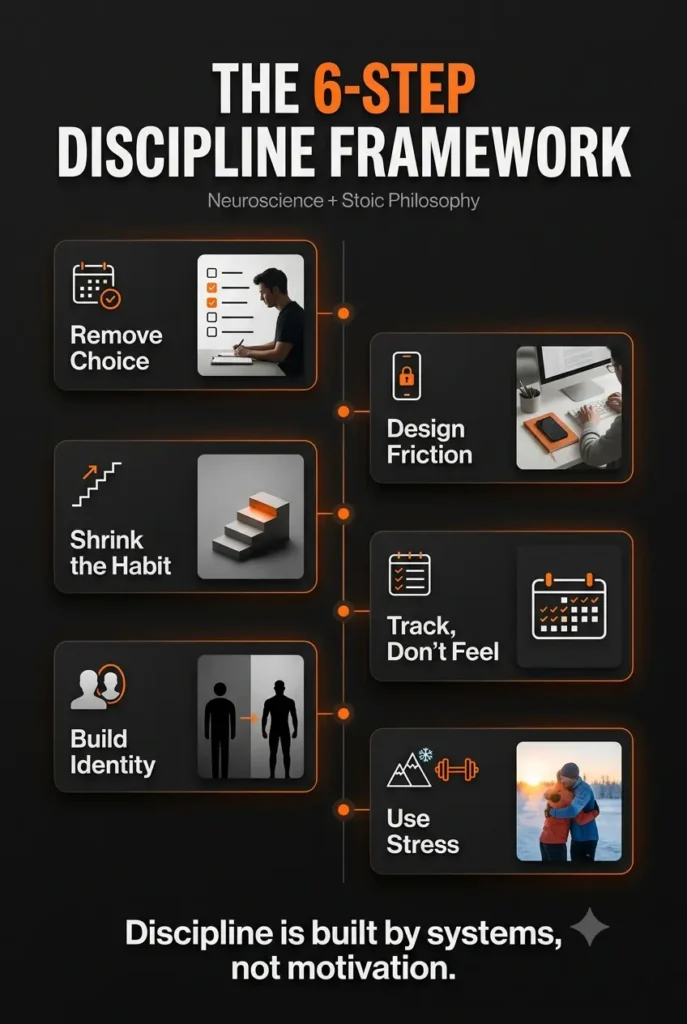
This is the system I built by combining what neuroscience says works with what the Stoics have known for two millennia. It’s not clever. It’s not exciting. It works because it removes the two things that were always sabotaging me: too many decisions, and too much friction.
1. Remove Choice — Pre-Decide Your Day
Decision fatigue is discipline’s silent killer. High performers don’t re-decide every morning whether to work out or write or show up — they’ve already decided, days or weeks in advance.
I fixed my wake-up time, my work blocks, and even my meals. I use implementation intentions now: if it’s 7 AM, I start my deep work block — no negotiation, no morning debate with myself.
Stoic alignment: act according to reason and role, not the mood you happen to wake up in.
2. Design Friction — Make the Wrong Choice Annoying
Your brain always chases the path of least resistance, so I stopped trying to resist temptation and started making it inconvenient instead.
I deleted distracting apps rather than “limiting” them — limits get overridden, deletion doesn’t. My phone lives in another room during work blocks. Anything that used to be one tap away now takes real effort to reach.
Stoic alignment: shape your environment to support virtue, not tempt you toward vice.
3. Shrink the Habit — Consistency Beats Intensity
I used to set enormous goals — an hour of exercise, a full report in one sitting — and burn out on the ambition before I ever started.
Now I go absurdly small. Five minutes of movement instead of an hour. One paragraph instead of a full report. The goal isn’t the output — it’s showing up, every single day, without exception.
Stoic alignment: show up daily, even in the smallest way. Consistency is the discipline.
4. Track, Don’t Feel — Data Over Motivation
Feelings lie constantly. Some days I feel unstoppable and get nothing done. Other days I feel dead on my feet and somehow finish everything on my list. I stopped trusting the feeling and started trusting the record.
I track execution, not motivation — habit streaks, weekly reviews, simple checkmarks. The data tells the truth my mood won’t.
Stoic alignment: this is the evening review in action — what did I actually do, and where did I actually fall short?
5. Build Identity — Become the Person Who Does the Work
This was the biggest internal shift for me. Behavior sticks when it matches identity, not when it matches a goal.
I stopped saying “I’m trying to be more disciplined” and started saying “I’m someone who finishes what they start.” Then I acted like it was already true, even on the days it wasn’t. Eventually, it just… was.
Stoic alignment: live according to your role and your rational nature, not your current impulse.
6. Use Stress, Don’t Avoid It — Voluntary Hardship
This is the one people resist most, and the one that matters most. Comfort atrophies discipline. Controlled stress builds it.
Cold exposure, physical training, distraction-free deep work — small, chosen discomforts that train your nervous system to handle the discomfort you didn’t choose.
Stoic alignment: voluntary hardship builds the resilience that makes everything else on this list possible.
My Actual Daily Blueprint
This isn’t theoretical. This is close to what my actual day looks like now, and it’s built entirely on the principles above.
Morning
- Same wake-up time, every day, no exceptions
- No phone for the first 30 minutes
- One priority task, tackled first, before anything else gets a vote
Day
- Time-blocked work, decided the night before
- Execution tracked, not motivation
- Friction removed from good habits, added to bad ones
Evening
- An honest review — no shame, just accounting
- Tomorrow’s top one to three tasks decided before I sleep
- Consistent bedtime, screens off
If you’re curious how this compares to what actually successful people run behind the scenes, I’ve broken down the daily routines of successful people I’ve studied and borrowed from — most of them are far less glamorous than social media makes them look.
What I Had to Stop Doing Immediately
Some of the biggest gains came not from what I added, but from what I finally dropped:
- Waiting for motivation to strike before starting
- Consuming self-help content without ever acting on it
- Building routines so ambitious I couldn’t sustain them past a week
- Trying to “fix my mindset” before I’d even attempt the task
- Blaming my personality for what was actually a systems failure
That last one stung the most to admit. But it was also the most freeing thing I’ve ever accepted about myself.
Where This Leaves You
If there’s one thing I want you to walk away with, it’s this: laziness is a signal, not a sin. It’s not proof that something is wrong with who you are. It’s your brain telling you something is wrong with how your day is designed.
Discipline isn’t a trait some people are born with and others aren’t. It’s a system — built through environment, identity, and small, unglamorous, consistent action, repeated on the days you don’t feel like it and the days you do.
The Stoics knew this two thousand years ago: control what’s yours to control, act according to reason, choose your hardships before life chooses them for you, and review yourself honestly every single night. If you want the fuller picture of how Stoic Discipline & Mental Strength work together as one system rather than two separate ideas, that’s where I’d point you next.
You don’t need more motivation. I certainly didn’t. You need fewer choices, a clearer system, and a stronger sense of who you’re choosing to become — starting today, not on the next Monday that feels like a fresh start.
Start absurdly small. Start today. That’s genuinely the whole secret.
Questions People Keep Asking Me About This
Is laziness a mental health issue?
Sometimes, yes — and it’s worth taking seriously rather than shaming away. Chronic “laziness” can overlap with burnout, depression, anxiety, or executive dysfunction linked to ADHD. If rest, better systems, and smaller habits don’t move the needle after a real, honest attempt, that’s a signal to talk to a professional rather than push harder on willpower alone.
How long does it take to build self-discipline?
Faster than most people expect, if you shrink the habit enough. I didn’t notice a shift after one big effort — I noticed it after about three weeks of absurdly small, consistent actions. The habit itself mattered less than the fact that I never missed a day.
What’s the difference between motivation and discipline?
Motivation is a feeling. It shows up uninvited and leaves the same way. Discipline is a system that doesn’t need the feeling to show up at all. The entire point of everything in this piece is to build something that works on the days motivation doesn’t.
Can Stoicism actually help with procrastination?
In my experience, more than almost anything else I’ve tried. Stoic philosophy isn’t about suppressing emotion — it’s about separating what’s in your control from what isn’t, and acting on the part that’s yours. Procrastination thrives on vague, overwhelming outcomes. The Dichotomy of Control shrinks the target down to just the next honest action, which is usually enough to break the freeze.
Do I need to overhaul my entire routine to fix this?
No — and trying to is usually what causes people to quit within a week. Pick one lever from this framework. Fix your wake-up time. Or remove one piece of friction. Or run one honest evening review. Small, sustained changes compound in a way that dramatic overhauls never do.
One Last Thing
I’m not writing this as someone who’s “arrived” at perfect discipline — I don’t think that person exists. I still have mornings where the resistance shows up, loud and familiar. The difference now is I know what it actually is, and I have a system that doesn’t depend on how I feel about it that day.
That’s really the whole shift: from fighting yourself to designing around yourself. From waiting to feel ready, to simply starting — badly, imperfectly, five minutes at a time — and letting the identity catch up to the action.
Marcus Aurelius didn’t wait to feel like a disciplined man before he got out of bed. He just told himself the truth: there was work to do, as a human being. Some mornings, that’s still the only line I need.

Abhishek Negi is the founder and content creator behind Peak Mode Life. He writes about fitness, nutrition, wellness, relationships, and healthy living. His goal is to simplify health information into practical, actionable advice that helps readers build sustainable habits and improve their overall quality of life.