
Most people don’t break because life gets too hard. They break because they were never taught how to carry weight. Stoic discipline is the old answer to a modern problem—the practice of controlling what you can, releasing what you can’t, and acting well regardless of how you feel. This guide explains what a stoic mindset actually is, why comfort quietly weakens you, and how to build mental strength through daily stoic practices that have survived 2,000 years for one reason: they work. You’ll get real examples of mental toughness, the wisdom of Marcus Aurelius, Seneca, Epictetus, and Musonius Rufus, a 30-day challenge, and honest answers about where Stoicism helps and where it doesn’t. No motivational fluff. Just the truth about how strong people get strong.
Quick answer: What is Stoic discipline?
Stoic discipline is the practice of governing your thoughts, reactions, and actions according to reason rather than emotion or impulse. Rooted in ancient Greek and Roman philosophy, it teaches you to focus only on what you control—your judgments and choices—while accepting everything outside your control with calm. The result is steady, durable mental strength that holds up under pressure, loss, and uncertainty.
Key Takeaways
- Control is the foundation. Stoicism divides life into what you control (your choices) and what you don’t (everything else). Strength comes from investing only in the first.
- Discipline beats motivation. Motivation fades within hours; discipline is a trained habit that works even when you feel nothing.
- Discomfort is training, not punishment. Voluntary hardship—cold, hunger, hard work—builds the nervous system’s tolerance for stress.
- Stoicism is not emotional suppression. It means feeling fully, then choosing your response with reason.
- Real resilience is built daily. Small, repeated practices compound; you don’t rise to the occasion, you fall to your training.
- Comfort is the modern threat. Instant gratification and constant stimulation erode the patience and grit that strength requires.
- The philosophy has survived because it works. Emperors, slaves, and prisoners of war all used the same principles to endure.
Why Most People Break Under Pressure
Most people break under pressure because they’ve spent years avoiding it. Strength is built through stress and recovery. Remove the stress entirely—through comfort, distraction, and instant relief—and the capacity to handle hardship quietly shrinks until a normal-sized problem feels unbearable.
Three modern forces accelerate this decline.
- Comfort addiction. Every discomfort now has a fix within reach. Bored? Scroll. Hungry? Delivery. Uncomfortable feeling? Numb it. The muscle of “sitting with hard things” atrophies from disuse.
- Instant gratification. Quick rewards trigger a dopamine release that feels good now but trains the brain to reject delayed payoff. Over time, repeated exposure to instant rewards rewires the reward system to demand more, faster (Akua Mind & Body).
- Comparison. Social media offers an endless feed of other people’s highlight reels, turning a normal life into a source of constant, low-grade inadequacy.
The pattern is simple. We’ve engineered hardship out of daily life, then act surprised when people can’t handle it. A mind never asked to struggle has no idea how strong it could be.
Fact box
In 2023, the suicide rate among males in the United States was nearly four times higher than among females—22.8 per 100,000 versus 5.9 per 100,000 (National Institute of Mental Health). Avoidance, isolation, and the absence of tools to process pain all play a role.
What Is a Stoic Mindset?
A stoic mindset is the habit of responding to life with reason instead of reaction. It is not coldness or detachment. It is the trained ability to pause between what happens to you and how you choose to answer—and to use that pause well.
Stoicism rests on a few core principles:
- The dichotomy of control. Some things are up to you; most are not. Peace comes from knowing the difference.
- Virtue as the only true good. Wisdom, courage, justice, and self-control are the foundation of a good life—not money, status, or comfort.
- Reason over impulse. Emotions are signals, not commands. You feel them, then you decide.
- Acceptance of nature. Aging, loss, and death are part of the deal. Fighting reality only adds suffering on top of pain.
The relevance hasn’t faded in two millennia. The same advice that steadied a Roman emperor and a freed slave steadies a founder facing bankruptcy or a parent facing a diagnosis.
The Stoic Control Principle
The single most useful idea in Stoicism is this: separate what you control from what you don’t, then act only on the first. Epictetus, born a slave, opened his teachings with it. “Some things are within our power, while others are not.”
| Things you can control | Things you cannot control |
|---|---|
| Your effort and actions | The outcome of your effort |
| Your judgments and opinions | What other people think of you |
| Your response to events | The events themselves |
| Your values and priorities | The economy, weather, traffic |
| How you treat people | How people treat you |
| The work you put in today | The past and the future |
When you pour energy into the right column, you guarantee frustration. When you pour it into the left, you build power. That single shift removes most of the anxiety people carry.
Answer box: What is the core rule of Stoicism?
The core rule of Stoicism is to focus only on what you can control—your thoughts, choices, and actions—and to accept everything else with calm. Epictetus called this the “dichotomy of control.” It teaches that suffering comes not from events themselves but from our judgments about them, so mastering your own response is the path to a steady mind.
The Survival Stoic: How Stoics Handle Hard Times
The survival stoic is not the calm philosopher in a quiet study. It is the person who keeps their head when everything falls apart—when the job ends, the marriage fails, the money runs out, or the diagnosis comes. Stoicism was built for exactly these moments, which is why its strongest examples come from people who suffered.
Marcus Aurelius ran the Roman Empire through war, plague, and betrayal, including a rebellion led by a trusted general. He wrote his private journal—now known as Meditations—not to teach others but to steady himself. His message to himself, again and again: control your mind, do your duty, accept the rest.
Epictetus was born a slave and reportedly had his leg broken by a cruel master. He became one of history’s most influential teachers. His core lesson was earned, not theorized: you can take everything from a man except his power to choose his response.
James Stockdale turned Stoicism into a survival manual. Shot down over Vietnam in 1965, he spent more than seven years as a prisoner of war, much of it in solitary confinement and torture. He credited Epictetus with keeping him sane. His insight, later named the Stockdale Paradox, became famous: you must hold unwavering faith that you will prevail, while confronting the brutal facts of your reality without illusion (Jim Collins). The prisoners who broke, he observed, were the optimists who kept setting dates—”out by Christmas”—and died of broken hearts when the dates passed.
The lesson holds across failure, loss, rejection, and crisis. Accept the situation honestly. Find the part you still control. Act on it. Repeat.
Mental Toughness Examples That Prove Stoicism Works
Mental toughness is not a personality trait you’re born with. It’s a learned response to hardship. The following mental toughness examples follow the same structure—problem, Stoic response, outcome—because that structure is the skill itself.
- Job loss. Problem: You’re laid off without warning. Stoic response: You can’t control the company’s decision, only your next move. You grieve briefly, then update your skills and reach out to your network daily. Outcome: The crisis becomes a forced reset rather than a collapse.
- Divorce. Problem: A marriage ends. Stoic response: You accept that you cannot control another person’s choices, only how you carry yourself and care for your kids. Outcome: You avoid bitterness and rebuild with dignity intact.
- Business failure. Problem: A company you built shuts down. Stoic response: You separate your worth from the outcome. The venture failed; you did not. Outcome: You extract the lessons and start again wiser.
- Financial hardship. Problem: Debt and shrinking income. Stoic response: You focus on the controllable—spending, side income, one hard decision at a time—instead of spiraling over the total. Outcome: Slow, steady recovery replaces panic.
- Rejection. Problem: A no from a person, school, or employer. Stoic response: You treat the rejection as information, not a verdict on your value. Outcome: You keep moving while others quit.
- Health setback. Problem: A serious diagnosis. Stoic response: You accept the body’s limits while controlling your attitude, your treatment choices, and your daily effort. Outcome: You face it with courage instead of being ruled by fear.
Fact box
The Stoics did not promise that hardship would disappear—only that your response to it was always yours. Stockdale survived more than seven years of captivity using principles a Roman emperor and a former slave had written down centuries earlier. The philosophy’s staying power is its track record under extreme stress.
The Four Pillars of Stoic Discipline
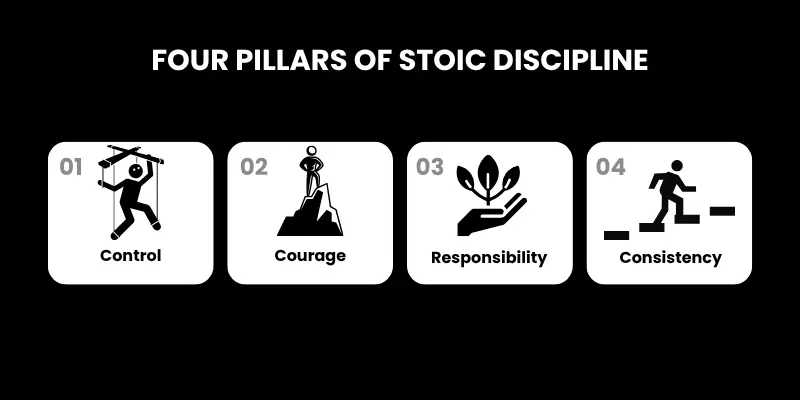
Stoic discipline rests on four pillars. Each builds on the last, turning philosophy into a way of living.
- Control. Direct your energy only toward what you can influence. This is the starting point and the recurring discipline. Everything else wastes energy.
- Courage. Do the hard, right thing despite fear. Courage isn’t the absence of fear; it’s acting well while afraid. Seneca wrote that we suffer more in imagination than in reality.
- Responsibility. Own your choices, your reactions, and your results. Stoicism rejects the victim mindset entirely. Blame is a tax you pay to avoid growth.
- Consistency. Repeat the right actions whether or not you feel like it. The Stoics valued the steady person over the inspired one. Discipline is consistency made automatic.
These four pillars convert good intentions into reliable behavior. The strong person is simply the one who practiced them when it was inconvenient.
10 Daily Stoic Practices That Build Resilience
Resilience is built in the boring hours, not the dramatic ones. These daily stoic practices are simple, repeatable, and proven over centuries. You don’t need all ten at once—start with two or three and add as they stick.
- Morning reflection. Before the day starts, name what’s in your control and set your intention. Marcus Aurelius prepared himself each morning for the difficult people he’d meet.
- Negative visualization. Briefly imagine losing what you have—your job, your health, your loved ones. This kills entitlement and deepens gratitude. The Stoics called it premeditatio malorum.
- Journaling. Write to examine your reactions, not to vent. Ask: What did I handle well? What controlled me that shouldn’t have?
- Voluntary discomfort. Take a cold shower, fast for a stretch, walk in the rain. Choosing hardship on your own terms builds tolerance for the hardship you don’t choose.
- Gratitude. Note what you’d miss if it were gone. Gratitude is the direct antidote to the comparison that social media feeds.
- Reading Stoic wisdom. A few pages of Meditations or Seneca’s letters each day keeps the principles fresh and present.
- Accountability. Tell someone your commitments. Private discipline is fragile; witnessed discipline holds.
- The view from above. Picture your problem from a great height—the scale of the city, the country, the centuries. Most worries shrink fast.
- Pause before reacting. Between trigger and response, insert one breath. That gap is where freedom lives.
- Evening review. Replay the day honestly. Praise what aligned with your values, correct what didn’t, then let it go.
Answer box: What is the most powerful daily Stoic practice?
The most powerful daily Stoic practice is the evening review—honestly examining your day’s actions against your values. Seneca practiced it nightly, asking what he did well, what he handled poorly, and how he could improve. This habit builds self-awareness, accountability, and steady character over time, which is why it remains the foundation of nearly every Stoic discipline routine.
Why Discipline Beats Motivation Every Time
Discipline beats motivation because motivation is a feeling and discipline is a decision. Feelings come and go with sleep, weather, and mood. Decisions, practiced enough, become automatic. The person who relies on motivation acts only when inspired. The disciplined person acts regardless.
| Motivation | Discipline |
|---|---|
| Depends on how you feel | Works no matter how you feel |
| Spikes and crashes | Steady and reliable |
| External (needs a spark) | Internal (a trained habit) |
| Fades within hours | Compounds over years |
| Easy to start, hard to sustain | Hard to start, easy to sustain |
| Looks for the right mood | Creates results in any mood |
This is why grounding practices matter. Building powerful mindfulness habits trains the same muscle Stoicism does—the ability to notice an impulse without obeying it. Motivation asks “do I feel like it?” Discipline never asks. It just acts.
Modern Habits That Destroy Mental Strength
Some habits quietly drain mental strength every day. They feel harmless because they’re normal—but normal isn’t the same as healthy. Each one trades long-term strength for short-term relief.
- Dopamine overload. Constant stimulation—notifications, short videos, junk food, gambling—keeps the brain’s reward system flooded and restless. Repeated quick rewards alter how the brain responds, making ordinary life feel flat (Luke Coutinho).
- Social media escapism. Hours spent watching others live drains the energy you need to live yourself, while fueling comparison and inadequacy.
- Numbing and avoidance. Compulsive habits used to escape discomfort—and many men struggling with this find that the decision to quit porn is one of the clearest tests of self-control and a turning point in rebuilding it.
- Victim mentality. Blaming circumstances feels protective but surrenders the one thing Stoicism says you always keep: your response.
- No clear purpose. Without a reason to endure hard things, every hard thing feels pointless. Purpose is what makes discipline bearable.
These habits don’t announce their damage. They erode strength slowly, which is exactly what makes them dangerous.
Fact box
Repeated exposure to instant rewards can push the brain’s reward center—the nucleus accumbens—into overdrive, raising dopamine to levels that make slower, earned rewards feel insufficient by comparison (Akua Mind & Body). The fix isn’t more stimulation. It’s deliberately practicing delay.
Stoic Quotes on Resilience and What They Really Mean
The best stoic quotes on resilience aren’t decoration. Each one is a compressed instruction. Here are seven worth living by.
- “You have power over your mind—not outside events. Realize this, and you will find strength.” — Marcus Aurelius. Meaning: Your strength lives in your reaction, not your circumstances. Application: When something goes wrong, ask only what’s still in your hands.
- “We suffer more often in imagination than in reality.” — Seneca. Meaning: Most fear is borrowed from a future that rarely arrives. Application: Name the actual worst case; it’s usually survivable, and the dread was worse than the event.
- “It’s not what happens to you, but how you react to it that matters.” — Epictetus. Meaning: Events are neutral; your judgment assigns the pain. Application: Change the story you tell about the event, and the weight changes.
- “The obstacle is the way.” — Marcus Aurelius (paraphrase). Meaning: What blocks you can be the path forward. Application: Treat the problem in front of you as the training, not the interruption.
- “No man is free who is not master of himself.” — Epictetus. Meaning: Freedom is self-control, not the absence of limits. Application: Win the small battles—your phone, your temper, your habits—to win the larger freedom.
- “How long are you going to wait before you demand the best for yourself?” — Epictetus. Meaning: The decision to change is available now, not someday. Application: Set the standard today, then meet it.
- “Choose not to be harmed—and you won’t feel harmed.” — Marcus Aurelius. Meaning: Much of harm is consent. Application: Refuse to let insults and setbacks define you.
The Mental Health Crisis of Modern Men: A Stoic Perspective
Modern men are struggling in measurable ways, and Stoicism, properly understood, offers part of the answer. The mental health crisis of men shows up in isolation, lost purpose, and a habit of avoiding emotion until it hardens into something worse. In 2023, the male suicide rate in the United States was nearly four times the female rate (National Institute of Mental Health). The drivers are familiar: loneliness, the loss of clear roles, and a culture that taught many men to bottle everything up.
Here’s the crucial correction. Stoicism is not emotional suppression. That misreading has done real harm. The Stoics never said don’t feel. They said feel fully, understand the feeling, then choose your response with reason. Suppression buries the emotion alive. Stoicism processes it.
What Stoicism actually offers men is structure:
- Responsibility restores agency to people who feel powerless.
- Purpose gives a reason to carry weight, which makes the weight bearable.
- Acceptance ends the exhausting war against reality.
- Self-examination through journaling and review surfaces what’s wrong before it festers.
One more honest note. Anxiety doesn’t only live in the mind; it shows up in the body and the head—the way anxiety causes brain fog, restless sleep, and a thinking that won’t settle. Stoic practice helps, and so does professional help. The two aren’t rivals.
Answer box: Is Stoicism healthy for mental health?
Yes, when practiced correctly, Stoicism supports mental health by building self-awareness, acceptance, and emotional regulation—skills that overlap with modern cognitive behavioral therapy. Stoicism teaches you to feel emotions fully and respond with reason, not to suppress them. It is not a replacement for professional treatment of serious conditions, but as a daily framework it reduces anxiety and strengthens resilience.
A 30-Day Stoic Challenge to Build Mental Strength
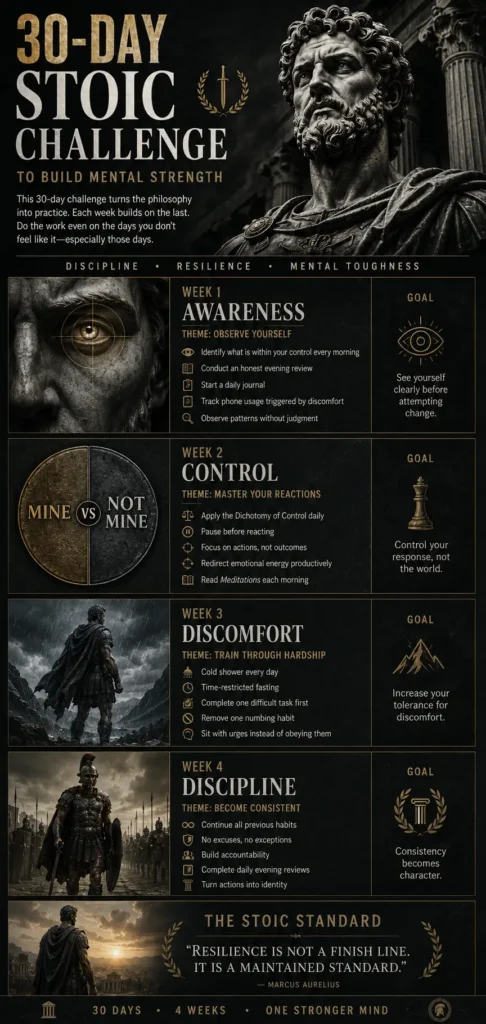
This 30-day challenge turns the philosophy into practice. Each week builds on the last. Do the work even on the days you don’t feel like it—especially those days.
Week 1: Awareness. Notice without changing anything yet. Each morning, name what’s in your control. Each evening, review your reactions honestly. Start a journal. Track how often you reach for your phone out of discomfort. The goal is to see your patterns clearly.
Week 2: Control. Apply the dichotomy of control daily. When something frustrates you, pause and sort it: mine or not mine? Redirect energy from outcomes to actions. Practice pausing before reacting at least once a day. Read a few pages of Meditations each morning.
Week 3: Discomfort. Introduce voluntary discomfort. Take a cold shower daily. Fast for a set window. Do one hard task before any easy reward. Cut one numbing habit—the scroll, the snack, the screen—and sit with the urge instead of obeying it.
Week 4: Discipline. Lock in consistency. Keep every practice from weeks one through three, no exceptions. Tell someone your commitments for accountability. End each day with the evening review. By now the practices should feel less like effort and more like identity.
After 30 days you won’t be finished—you’ll be started. Resilience isn’t a finish line. It’s a maintained standard.
Common Myths About Stoicism
Stoicism is widely misunderstood. Clearing up the myths makes the real philosophy more useful.
- Myth: Stoics have no emotions. Truth: Stoics feel deeply. They simply refuse to be ruled by emotion. The goal is mastery, not absence.
- Myth: Stoicism means suffering silently. Truth: It means enduring with reason and dignity—not pretending pain doesn’t exist or refusing to address it.
- Myth: Stoics never ask for help. Truth: Musonius Rufus and Seneca both taught and learned in community. Asking for help is a rational act, not a weakness.
- Myth: Stoicism is outdated. Truth: Its core ideas underpin modern cognitive behavioral therapy. The principles are 2,000 years old; the application is current.
- Myth: Stoicism is toxic masculinity. Truth: Stoicism teaches justice, kindness, and emotional honesty for everyone. Suppressing feelings and dominating others is the opposite of what the Stoics taught.
Final answer box: How do you become mentally strong?
You become mentally strong by practicing discipline daily, accepting what you can’t control, and deliberately doing hard things. Build mental strength through consistent daily stoic practices—morning reflection, voluntary discomfort, journaling, and an honest evening review. Strength isn’t a trait you’re born with; it’s the result of repeated choices to act with reason instead of impulse, especially when it’s difficult.
Final Thoughts: Life Doesn’t Get Easier, You Get Stronger
Here’s the truth no one wants to hear: life is not going to get easier. The bills, the losses, the setbacks, and the uncertainty are permanent features, not temporary obstacles. Waiting for calmer conditions is a waste of the years you have.
So the work is on you. Not the world—you. The Stoics understood this two thousand years ago, and nothing about human nature has changed since. The emperor, the slave, and the prisoner of war all reached the same conclusion: you cannot control what happens, but you can become the kind of person who handles whatever does.
Ask yourself one question tonight. What would change if I stopped waiting for life to soften and started training myself to be harder to break?
Then start small. Pick two daily stoic practices and do them tomorrow. Do them the day after. The strength you’re looking for isn’t found—it’s built, one disciplined choice at a time.
Frequently Asked Questions
What is Stoic discipline?
Stoic discipline is the practice of training your mind to focus on what you can control while accepting what you cannot. Rooted in ancient Stoic philosophy, it emphasizes self-control, rational thinking, emotional regulation, and consistent action. Rather than reacting impulsively to challenges, a person practicing Stoic discipline learns to respond thoughtfully, remain calm under pressure, and stay committed to their values regardless of external circumstances.
How does Stoicism build mental strength?
Stoicism builds mental strength by teaching individuals to face difficulties with acceptance, courage, and self-control. Instead of avoiding discomfort or seeking constant comfort, Stoics view challenges as opportunities to develop character and resilience. Over time, practicing Stoic principles strengthens emotional stability, improves decision-making under pressure, and helps individuals recover more effectively from setbacks, failures, and adversity.
What is a Stoic mindset?
A Stoic mindset is a way of thinking that prioritizes reason, personal responsibility, and emotional resilience. People with a Stoic mindset focus their energy on actions and attitudes they can control rather than worrying about outcomes or external events. This perspective helps them remain steady during uncertainty, maintain inner peace during challenges, and approach life with greater discipline and purpose.
What are the best daily Stoic practices?
The most effective daily Stoic practices include morning reflection, journaling, gratitude, negative visualization, self-examination, and focusing on what is within your control. Many Stoics also practice voluntary discomfort, such as taking cold showers or simplifying daily comforts, to build resilience. Consistently applying these habits helps strengthen self-awareness, discipline, and emotional stability over time.
Can Stoicism reduce anxiety?
Stoicism can help reduce anxiety by encouraging individuals to separate what they can control from what they cannot. Much anxiety comes from worrying about future events, other people’s opinions, or outcomes that are beyond our influence. Stoic teachings redirect attention toward present actions and personal responsibility, helping reduce unnecessary stress and creating a calmer, more balanced mindset.
What is the survival stoic philosophy?
The survival stoic philosophy is the application of Stoic principles during difficult or uncertain circumstances. It focuses on enduring hardship with resilience, maintaining emotional control during adversity, and finding strength in personal responsibility. Rather than viewing obstacles as unfair punishments, survival Stoics see them as opportunities to develop character, adaptability, and mental toughness.
How do Stoics handle failure?
Stoics handle failure by viewing it as feedback rather than a reflection of their worth. They understand that outcomes are never fully within their control, but effort, preparation, and attitude are. When failure occurs, a Stoic examines what can be learned, accepts the result without self-pity, and takes constructive action to improve. This mindset transforms setbacks into opportunities for growth.
What are examples of mental toughness?
Mental toughness can be seen when someone remains calm during a crisis, continues working toward a goal despite setbacks, accepts criticism without becoming defensive, or maintains discipline when motivation disappears. Historical figures such as Marcus Aurelius, Epictetus, and James Stockdale demonstrated mental toughness by enduring extreme challenges while maintaining their principles and emotional stability.
Does Stoicism improve self-control?
Yes, Stoicism is highly effective at improving self-control because it teaches individuals to pause before reacting to emotions, impulses, and external events. By practicing awareness and focusing on rational decision-making, Stoics learn to manage anger, temptation, fear, and frustration more effectively. Over time, this leads to better habits, stronger discipline, and greater personal responsibility.
What is voluntary discomfort?
Voluntary discomfort is a Stoic practice that involves intentionally exposing yourself to manageable challenges or inconveniences. Examples include taking a cold shower, fasting for a short period, walking instead of driving, or reducing unnecessary luxuries. The purpose is to build resilience, reduce dependence on comfort, and develop confidence in your ability to handle adversity when it inevitably arises.
How long does it take to build resilience?
Building resilience is an ongoing process rather than a destination. Some improvements can be noticed within a few weeks of practicing Stoic habits such as journaling, reflection, and emotional regulation. However, lasting resilience develops through consistent exposure to challenges, disciplined responses, and repeated practice over months and years. Like physical strength, mental resilience grows through continual training.
Are Stoics emotionless?
No, Stoics are not emotionless. One of the biggest misconceptions about Stoicism is that it teaches people to suppress their feelings. In reality, Stoicism encourages individuals to understand, manage, and respond wisely to emotions rather than being controlled by them. Stoics experience sadness, joy, fear, and anger like everyone else, but they strive to avoid letting emotions dictate their actions.
Which Stoic philosopher should beginners read first?
For most beginners, Marcus Aurelius is an excellent starting point because his writings are practical, relatable, and focused on everyday challenges. His book Meditations offers valuable insights into self-discipline, resilience, and personal responsibility. Epictetus is also highly recommended for understanding the Stoic concept of control, while Seneca provides practical advice on handling adversity, success, and human relationships.
Is Stoicism good for modern men?
Stoicism can be particularly valuable for modern men because it encourages responsibility, emotional mastery, resilience, and purpose. In a world filled with distractions, uncertainty, and social pressures, Stoic principles provide a practical framework for handling stress, building discipline, and developing character. However, Stoicism does not encourage emotional suppression; it promotes emotional intelligence and thoughtful action.
How can I start practicing Stoicism today?
You can start practicing Stoicism today by identifying what is within your control and focusing your energy there. Begin a daily journal, reflect on your reactions to challenges, practice gratitude, and pause before responding to difficult situations. Reading a few pages from Marcus Aurelius or Epictetus each day can also deepen your understanding. The key is consistency—small daily actions gradually build a stronger and more resilient mindset.

Abhishek Negi is the founder and content creator behind Peak Mode Life. He writes about fitness, nutrition, wellness, relationships, and healthy living. His goal is to simplify health information into practical, actionable advice that helps readers build sustainable habits and improve their overall quality of life.