Quick Answer: Monk mode is a 30-day, time-bound focus protocol where you eliminate distractions (social media, junk food, entertainment), lock in one primary goal, and follow a strict daily routine of deep work, exercise, sleep, and reflection. To start: define one measurable goal, set a fixed start/end date, remove distracting apps, build a repeatable daily schedule with two 90–120 minute deep-work blocks, and track your progress weekly.
If you’ve ever felt like your days disappear into notifications, half-finished tasks, and scattered attention, monk mode isn’t just another productivity trend — it’s a structured reset. This guide breaks down exactly how to enter monk mode, the monk mode rules that actually work, a full monk mode routine, and the science behind why this 30 day productivity challenge delivers real results when done right.
Key Takeaways
- Monk mode is a temporary, goal-bound sprint — not permanent isolation. It has a clear start date, end date, and one primary objective.
- The core monk mode rules include no social media, no junk food/alcohol, consistent wake/sleep times, daily exercise, meditation, and single-task deep work.
- A 30 day monk mode challenge works because it’s long enough to build habits but short enough to stay motivating.
- The biggest monk mode benefits are laser focus, better sleep, dopamine regulation, and measurable output on your main goal.
- Most people who complete a monk mode challenge see a 30–50% drop in screen time and keep 2–3 new habits long after Day 30.
- Success depends on avoiding common traps: open-ended timelines, too many goals, extreme isolation, and no exit plan.
What Is Monk Mode? (Definition + Context)
Monk mode is a self-imposed period — typically 30 days — where you deliberately cut out distractions like social media, entertainment, and non-essential commitments to focus intensely on one clearly defined goal. It borrows its name from monastic discipline and solitude, but the modern version is built for real life: knowledge work, creative projects, exam prep, fitness transformations, or launching a business.
The key distinction: monk mode is not about disappearing from the world. It’s a structured sprint with rules, a finish line, and a specific outcome you’re working toward. Think of it as a self improvement challenge with guardrails — you’re not quitting your job or ghosting your friends, you’re removing noise so your energy goes toward what matters most.
This is also why monk mode pairs so well with related practices like a dopamine detox, a disciplined morning routine, or even a broader lifestyle reset like the Winter Arc challenge — they all share the same underlying principle of removing friction between you and your goals.
Why Monk Mode Works: The Science and Psychology
Monk mode isn’t just discipline for its own sake — it’s grounded in a few well-documented psychological mechanisms.
1. Deep Work and Attention
Long, protected focus blocks reduce context switching. Every time you check a notification mid-task, your brain pays a “switching cost” that can take over 20 minutes to fully recover from. Monk mode’s deep-work blocks eliminate this by design, allowing you to enter flow states where output quality and speed both improve.
2. Dopamine Regulation
Constant exposure to high-stimulation inputs — short-form video, social feeds, junk food — trains your brain to expect quick rewards. Removing these inputs during monk mode functions similarly to a dopamine detox: it resets your baseline sensitivity, so that focused, slower work starts to feel satisfying again instead of boring.
3. Habit Formation
Thirty days is a practical middle ground. It’s long enough to establish new routines around sleep, exercise, and reading, but short enough that it doesn’t feel like an indefinite lifestyle overhaul. This is the same logic behind other 30-day resets like the Winter Arc or a 30-day No Fap challenge — a defined runway makes discipline easier to sustain.
4. Decision Fatigue Reduction
Every choice you make during the day draws from a limited pool of mental energy. Pre-planning meals, clothing, and schedules during monk mode frees up that energy for your one priority goal instead of burning it on small decisions.
Research on digital detoxes and focused-work sprints consistently shows measurable improvements in mood, perceived focus, and reduced screen time within 2–4 weeks — which lines up almost exactly with a 30-day monk-mode cycle.
Monk Mode Rules: The Core Framework
Every effective monk mode protocol follows a consistent rule set. These aren’t arbitrary — each one closes off a specific leak in your focus, energy, or willpower.
Hard Rules (Non-Negotiable for 30 Days)
| Rule | What It Means |
|---|---|
| No social media | Delete apps entirely or use blockers; cap usage at 30 minutes/day only if required for work |
| No alcohol, no junk food | Eliminate substances and foods that impair sleep, energy, and willpower |
| No mindless entertainment | No binge-watching, YouTube spirals, or gaming outside planned, limited windows |
| One primary goal | A single, measurable outcome — e.g., “finish chapters 1–5” or “launch MVP” |
| Consistent wake time | Same alarm daily to anchor your circadian rhythm |
| Daily exercise | 30–60 minutes of movement — weights, cardio, or yoga |
| Daily meditation or stillness | 10–20 minutes to train attention and reduce reactivity |
| Fixed sleep schedule | 7.5–9 hours nightly, no screens 60 minutes before bed |
Soft Rules (Highly Recommended)
- Cold shower or morning sunlight — signals alertness and reinforces discipline (see our full breakdown of cold shower benefits)
- Daily reading — 20–30 minutes of non-fiction or skill-related material
- Evening journaling — reflect on wins, distractions, and one improvement for tomorrow
- No complaining or gossip — protect your mental environment as rigorously as your physical one
These rules work together as a system. Removing distractions without fixing sleep, or exercising without controlling screen time, tends to produce weaker results. The combination is what makes monk mode different from a simple to-do list — and it’s the same reason a disciplined morning routine amplifies everything else you do during the day.
How to Enter Monk Mode: Step-by-Step (Days 0–3)
Knowing how to do monk mode correctly starts before Day 1. Rushing into the rules without preparation is one of the fastest ways to quit by Day 5.
Day 0–1: Define Scope and Exit Criteria
- Write a one-sentence goal and a clear definition of “done.”
- Choose your 30-day start and end date, and write both down somewhere visible.
- List the distractions you’ll eliminate (apps, sites, commitments) and the non-negotiables you’ll keep (sleep, exercise, key relationships).
Day 2: Audit and Prepare Your Environment
- Delete social apps and install website blockers (Freedom, SelfControl, or similar).
- Clear your workspace of visual clutter.
- Prep meals, outfits, and break schedules in advance to reduce daily decision-making.
- Tell family, roommates, or colleagues about your focus windows so interruptions drop.
Day 3: Establish Your Baseline and Rituals
- Log your starting point: sleep hours, mood, a 1–10 focus rating, and daily screen-time minutes.
- Create a start ritual — a few minutes of meditation, writing down your goal, and setting a timer for your first deep-work block.
This groundwork matters. Many of the self-discipline techniques that make monk mode sustainable — like environment design and pre-commitment — are set up in these first three days, not improvised on the fly.
30-Day Monk Mode Routine: Sample Daily Schedule
Use this as a monk mode routine template and adapt the timing to your own life and job constraints.
| Time | Activity |
|---|---|
| 05:30–06:00 | Wake, cold shower, 3-line journal (goal, “won’t do,” gratitude) |
| 06:00–08:00 | Deep-work block #1 — priority goal, no phone |
| 08:00–09:00 | Exercise — weights, run, or yoga |
| 09:00–12:00 | Regular work/study — batch emails and meetings |
| 12:00–13:00 | Lunch + short walk, no screens |
| 13:00–15:00 | Deep-work block #2 or skill practice |
| 15:00–18:00 | Regular work/study |
| 18:00–20:00 | Dinner, reading, light walk |
| 20:00–21:30 | Optional deep-work or review, if energy allows |
| 21:30–22:30 | Wind down — no screens, light stretch, journal |
| 22:30 | Sleep |
Key Principles Behind the Schedule
- Same wake time daily anchors your circadian rhythm and makes mornings easier over time.
- Deep-work blocks run 90–120 minutes, single-task, with a visible timer running.
- Breaks are real breaks — walk, eat, look outside. No phone during recovery windows.
This structure is the backbone of deep focus productivity: it’s not about working more hours, it’s about protecting fewer, higher-quality hours from interruption.
Weekly Structure: How to Progress Across 30 Days
Week 1 (Days 1–7): Detox and Setup
Focus on removing distractions and establishing sleep and exercise routines. Expect withdrawal symptoms — the urge to scroll, boredom, restlessness. Use a 10-minute delay rule before giving in to any craving. Track your clean deep-work blocks daily.
Week 2 (Days 8–14): Build Rhythm
Add 30–60 minutes of daily exercise if you haven’t already. Increase deep work to two full blocks per day (3–4 hours total). Start a weekly review: what worked, what slipped, and what needs adjusting.
Week 3 (Days 15–21): Intensity and Output
Push for peak output on your primary goal. Maintain the no-social-media rule strictly — if you slip, log it and reset the same day rather than abandoning the challenge. Consider adding one “light” evening with 30 minutes of planned entertainment to prevent burnout.
Week 4 (Days 22–30): Finish Strong and Plan Re-Entry
Complete your measurable milestones — draft chapters, MVP features, exam modules. Re-test your baseline: compare focus rating, mood, and screen time to Day 1. Start planning your re-entry: decide which habits you’ll keep, such as morning deep work or no phone in the first 30 minutes of the day.
Monk Mode Benefits: What You Can Realistically Expect
Based on user reports and related research on focus sprints and digital detoxes:
- Laser focus — less mental whiplash, more real progress on your priority goal
- Mental clarity — reduced noise leads to clearer thinking and decision-making
- Peak productivity — 3–4 hours of true deep work daily can outperform 8 hours of fragmented, interrupted work
- Discipline and confidence — keeping hard rules for 30 days builds self-trust and resilience, the same outcome people report from a No Fap challenge or a Winter Arc
- Better sleep and energy — fixed sleep/wake times and reduced stimulants improve rest and daytime energy
- Dopamine reset — less reliance on quick entertainment hits, so focused work starts to feel rewarding on its own
These aren’t overnight effects. Most people notice meaningful shifts by the end of Week 2, with the biggest gains compounding through Weeks 3 and 4.
Common Mistakes and How to Avoid Them
| Mistake | Why It Fails | Fix |
|---|---|---|
| Open-ended monk mode | No finish line leads to drift and quitting | Set a fixed end date before Day 1 |
| Too many goals | Diffused attention, shallow progress everywhere | One primary goal only — everything else is secondary |
| Extreme isolation | Loneliness, burnout, resentment from those around you | Keep key relationships; cut mindless inputs, not humans |
| Unrealistic schedules | 12-hour days lead to a crash by Week 2 | Start with two deep-work blocks a day and build gradually |
| No exit plan | Post-monk-mode chaos undoes your gains | Decide in advance which habits you’ll keep and how you’ll reintegrate |
Understanding motivation vs discipline is especially useful here — motivation will fade by Week 2 no matter how excited you were on Day 1. Monk mode only works long-term when it’s built on discipline and systems, not willpower alone.
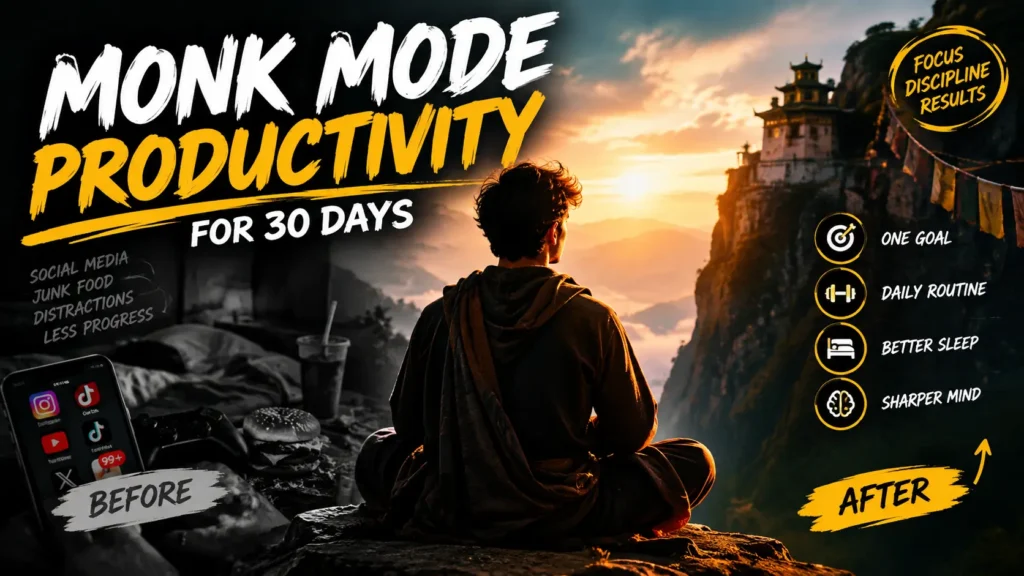
Monk Mode Transformation: Before/After Expectations
Individual results vary, but a well-run 30-day monk mode typically produces:
- Screen-time reduction: a 30–50% drop in daily phone usage
- Output increase: completion of a major project milestone that had been stalled for months
- Habit carryover: 2–3 new routines — like morning deep work, daily exercise, or no phone in the first 30 minutes — that persist well after Day 30
- Subjective gains: higher focus ratings, improved mood, and stronger confidence in your own self-discipline
The monk mode transformation isn’t just about the 30 days themselves — it’s about proving to yourself that you can follow through on a hard commitment, which tends to raise your baseline standards for everything afterward.
Monk Mode vs. Dopamine Detox: What’s the Difference?
These two are often confused, but they’re not the same thing.
| Comparison | Monk Mode | Dopamine Detox |
|---|---|---|
| Duration | Typically 30 days | Often 24 hours to 7 days |
| Goal | Achieve one specific, measurable outcome | Reduce dependence on constant stimulation and rebuild focus |
| Scope | Full lifestyle protocol covering sleep, exercise, diet, work, and habits | Primarily focused on removing highly stimulating inputs |
| Structure | Follows a defined daily routine with deep-work blocks and strict habits | More flexible structure centered around abstinence from distractions |
In practice, a dopamine detox is often the first step inside a monk-mode challenge — Week 1 of monk mode functions almost identically to a dopamine reset before you shift into deeper output-focused work in Weeks 2–4.
Tools and Trackers to Support Monk Mode
- App blockers: Freedom, SelfControl, or Forest to lock distracting sites and apps
- Habit tracker: A simple checklist or printable 30-day grid to mark daily adherence
- Time tracker: Built-in phone screen-time stats or an app like Toggl to log your deep-work blocks
- Journal template: A 3-line nightly log covering goal progress, distraction log, and one improvement for tomorrow
Pairing these tools with the self-discipline techniques you’re already building makes it far easier to stay consistent when motivation naturally dips mid-challenge.
Quick-Start Checklist
Use this before you begin your monk mode challenge:
- Write your one-sentence goal and definition of “done”
- Choose your 30-day start and end dates and write them down
- Delete or block social media and entertainment apps
- Set fixed wake and sleep times
- Plan two daily deep-work blocks (90–120 minutes each)
- Schedule daily exercise and meditation
- Create a simple tracker — paper or digital — for daily adherence
- Tell family or colleagues about your focus windows
- Decide in advance which 2–3 habits you’ll keep after Day 30
Frequently Asked Questions
What is monk mode in productivity terms?
Monk mode is a time-bound, 30-day protocol combining deep-work blocks, distraction elimination, and disciplined daily routines to achieve one high-leverage goal.
How do I start monk mode as a beginner?
Start by defining one measurable goal, setting a fixed 30-day start and end date, removing distracting apps, and building a daily schedule around two deep-work blocks, exercise, and consistent sleep.
Is monk mode the same as a dopamine detox?
No. A dopamine detox is a shorter reset (often days) focused on removing stimulation, while monk mode is a longer, full-lifestyle protocol built around achieving a specific goal.
How long should monk mode last?
30 days is the most common and effective length — long enough to build habits, short enough to stay motivating without burning out.
Can I still see friends and family during monk mode?
Yes. Monk mode targets mindless distractions and low-value inputs, not meaningful relationships. Isolating from people entirely often backfires and leads to burnout.
What happens after the 30 days end?
Plan your re-entry in advance. Most people keep 2–3 habits — like a disciplined morning routine, daily exercise, or limited phone use — while gradually reintroducing other activities.
Does monk mode actually improve productivity?
Yes. Removing distractions and protecting deep-work time reduces context-switching costs, which research links to faster, higher-quality output compared to fragmented, interrupted work
Monk mode isn’t about becoming a different person for 30 days — it’s about removing everything that’s been quietly draining your focus so you can finally see what you’re capable of when nothing is competing for your attention. Set your date, write your goal, and start Day 1 with the schedule above.

Abhishek Negi is the founder and content creator behind Peak Mode Life. He writes about fitness, nutrition, wellness, relationships, and healthy living. His goal is to simplify health information into practical, actionable advice that helps readers build sustainable habits and improve their overall quality of life.