
Quick Answer
To be self disciplined, stop relying on motivation and start building small, repeatable habits tied to your identity. Reduce the number of decisions you make, remove friction from good actions, and design an environment that makes the right choice easy. Discipline is not force of will. It is the practice of keeping small promises to yourself until they become who you are.
Key Takeaways
- Discipline is an identity you build, not a feeling you wait for.
- Motivation is unreliable; systems and environment do the heavy lifting.
- Small, consistent actions rewire your brain over time through neuroplasticity.
- Removing friction matters more than adding willpower.
- Most failure comes from decision fatigue, poor environment, and unrealistic goals.
- Reflection at the end of each day quietly strengthens tomorrow’s choices.
- The goal is not to feel disciplined, but to become someone who acts regardless of feeling.
Most people believe discipline is a battle. They picture a person gritting their teeth, forcing themselves out of bed, pushing against every desire until sheer willpower wins.
I once believed the same thing. Years later, after watching thousands of people struggle with the same problem, I realized something quieter and far more useful.
Discipline is not about forcing yourself. It is about becoming someone who keeps promises to themselves. That shift sounds small. It changes everything.
This guide is not here to motivate you. Motivation fades by lunchtime. Instead, I want to show you how to be self disciplined in a way that lasts, using both timeless philosophy and modern behavioral science. No shouting. No slogans. Just what actually works.
What Does Being Self-Disciplined Really Mean?
Being disciplined means acting according to what you value, even when you do not feel like it. That is the whole definition. Everything else is detail.
Notice what it does not say. It does not say you must feel motivated. It does not say you must never struggle. Discipline lives in the gap between how you feel and what you do.
Discipline versus motivation
Motivation is an emotion. It comes and goes with your mood, your sleep, and the weather. Building a life on it is like building a house on the tide.
Discipline is a decision that no longer needs to be made each time. You do the thing because it is who you are, not because you feel inspired.
Discipline as identity
I noticed something interesting after watching disciplined people for decades. They rarely talked about willpower. They spoke about who they were.
A person who says “I am someone who trains” acts differently from someone trying to force themselves to exercise. The action flows from the identity, not the other way around.
Discipline as freedom
Here is the part most people miss. Discipline is not a cage. It is freedom.
The person who controls their impulses is not ruled by them. They are free to choose. That freedom is the quiet reward waiting on the other side of consistency.
Why Most People Fail to Stay Disciplined

If you have tried many times and failed, you are not lazy. You are human, and you are working against forces most people never name. Understanding them is the first step in learning how to stay disciplined.
Decision fatigue
Every choice you make drains a limited supply of mental energy. By evening, your capacity to resist temptation is nearly gone.
This is why good intentions collapse at night. It is not weakness. It is arithmetic. Fewer decisions mean more discipline.
Dopamine and easy pleasure
Your brain is wired to seek reward with the least effort. Your phone offers endless small hits of dopamine, and deep work cannot compete on those terms.
The problem is not that you lack discipline. It is that you are competing against systems designed to capture your attention.
Distraction and environment
Most people try to fix their behavior while leaving their environment untouched. That rarely works.
If the temptation is within arm’s reach, you will lose more often than you win. Environment shapes behavior more powerfully than intention.
Emotional decisions
We often decide based on how we feel in the moment, then justify it afterward. The tired mind is a poor negotiator.
This constant emotional decision-making is part of why so many people quietly struggle. It also connects to the wider men’s mental health crisis, where unspoken pressure and exhaustion erode the will to keep going. Discipline suffers when the mind is already carrying too much.
No real system
Finally, most people rely on effort instead of structure. They wake up hoping to feel disciplined. Hope is not a method. A system is.
The Stoic Philosophy of Discipline
The Stoics understood discipline long before neuroscience gave it a name. Their insight was simple and durable.
Focus on what you control
You cannot control outcomes, other people, or how you feel. You can control your actions and your responses.
Discipline begins the moment you stop wrestling with what is outside your power and start directing what is within it. This is the heart of Stoic Discipline & Mental Strength.
Practice voluntary discomfort
The Stoics chose small hardships on purpose. A cold walk. A simple meal. A missed comfort.
They did this not to suffer but to prove that comfort was not their master. When you practice discomfort by choice, unwanted discomfort loses its grip on you.
Character over feeling
For the Stoic, the aim was not success or pleasure. It was character. To act well, consistently, regardless of circumstance.
This reframes discipline entirely. You are not chasing a goal. You are becoming a certain kind of person.
Responsibility
The Stoic takes full ownership. Not blame, but responsibility. The moment you say “this is mine to handle,” you reclaim your power to act.
Consistency then becomes a form of self-respect. You keep your word to yourself the way you would keep it to someone you admire.
The Science Behind Self-Discipline
Philosophy tells us why discipline matters. Science shows us how it forms. The two agree more than you might expect.
The habit loop
Every habit follows a simple pattern: cue, routine, reward. A trigger prompts an action, and the action delivers a payoff.
To build discipline, attach a clear cue to a small routine and let the reward reinforce it. To break a bad habit, disrupt the cue.
Neuroplasticity
Your brain physically changes with repetition. Each time you repeat an action, the neural pathway grows stronger and easier to travel.
This is why discipline gets easier over time. You are literally wiring yourself. The first repetitions are hard because the road is new.
Dopamine and delayed gratification
Dopamine drives you toward reward. When you delay gratification, you train your brain to value long-term rewards over instant ones.
Studies on delayed gratification link this ability to better outcomes across life. The good news is that it can be strengthened, like a muscle.
Executive function
Your prefrontal cortex handles planning and self-control. When you are tired, stressed, or mentally foggy, this system weakens.
That is why sleep and mental clarity matter so much. Persistent brain fog issues make even simple discipline feel impossible, because the very system you need to rely on is offline.
Identity-based habits
Behavioral research shows that habits stick best when tied to identity. You are not trying to run; you are becoming a runner.
Each small action becomes a vote for the person you are choosing to be. Enough votes, and the identity holds.
How Do I Discipline Myself?
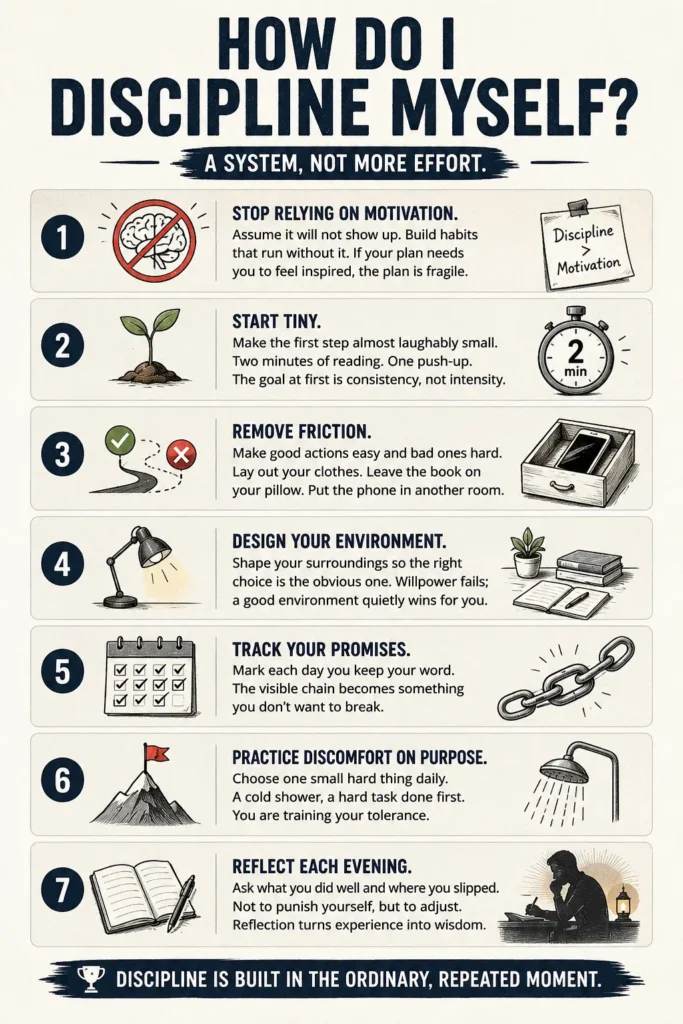
This is the question I hear most often. “How do I discipline myself when I have already failed so many times?” The answer is a system, not more effort. Here is a step-by-step framework.
1. Stop relying on motivation. Assume it will not show up. Build habits that run without it. If your plan needs you to feel inspired, the plan is fragile.
2. Start tiny. Make the first step almost laughably small. Two minutes of reading. One push-up. The goal at first is consistency, not intensity.
3. Remove friction. Make good actions easy and bad ones hard. Lay out your clothes. Leave the book on your pillow. Put the phone in another room.
4. Design your environment. Shape your surroundings so the right choice is the obvious one. Willpower fails; a good environment quietly wins for you.
5. Track your promises. Mark each day you keep your word. The visible chain becomes something you do not want to break.
6. Practice discomfort on purpose. Choose one small hard thing daily. A cold shower, a hard task done first. You are training your tolerance.
7. Reflect each evening. Ask what you did well and where you slipped. Not to punish yourself, but to adjust. Reflection turns experience into wisdom.
These steps are not dramatic. That is exactly why they work. Discipline is built in the ordinary, repeated moment.
15 Self-Discipline Techniques That Actually Work
These are practical self-discipline techniques drawn from both Stoic practice and behavioral science. You do not need all of them. Choose two or three and begin.
1. The Two-Minute Rule. Shrink any habit to something you can do in two minutes. Starting is the hardest part; make it tiny and you remove the excuse.
2. Habit Stacking. Attach a new habit to an existing one. “After I pour my coffee, I write one sentence.” The old habit becomes the cue for the new.
3. Time Blocking. Assign tasks to specific slots in your day. When time is decided in advance, you spend less energy deciding what to do next.
4. Temptation Bundling. Pair something you should do with something you enjoy. Listen to a favorite podcast only while exercising.
5. Digital Fasting. Set periods where screens are off entirely. This restores attention and weakens the dopamine loop that erodes focus.
6. No Zero Days. Never let a day pass with nothing done. Even one small action counts. This protects the chain and your identity.
7. Environment Design. Arrange your space to support your goals. Remove the junk food. Hide the distractions. Make good behavior the default.
8. Identity-Based Habits. Frame actions around who you are becoming. Ask, “What would a disciplined person do here?” Then do that.
9. Visual Tracking. Use a calendar or habit tracker you can see. Progress made visible is progress protected.
10. Delayed Gratification. Practice waiting on purpose. Pause before reacting to a craving. Each pause strengthens your control.
11. Implementation Intentions. Decide in advance: “When X happens, I will do Y.” This removes hesitation in the moment.
12. The One-Minute Reset. When you slip, return immediately. One bad choice is a mistake; two in a row starts a pattern.
13. Single-Tasking. Do one thing at a time with full attention. Multitasking drains executive function and fractures your focus.
14. Morning Priming. Do your hardest task early, when willpower is fresh. The day rarely gets easier as it goes on.
15. Evening Reflection. Close each day with an honest review. This is the Stoic’s oldest tool and still one of the most powerful.
Daily Discipline Habits That Stick
Techniques matter, but rhythm matters more. Discipline lives in the shape of your day. Here is a simple structure you can adapt.
Morning
- Wake at a consistent time. A stable start anchors the whole day.
- Do one small hard thing first, before comfort creeps in.
- Tackle your most important task while your mind is clear.
The morning sets the tone. Win it quietly, and the rest follows more easily.
Afternoon
- Take real breaks to protect your energy and focus.
- Move your body, even briefly, to reset your mind.
- Guard your attention. Batch messages instead of reacting all day.
The afternoon is where fatigue begins. A short walk often does more than another coffee.
Evening
- Step away from screens before bed to protect your sleep.
- Prepare tomorrow so your future self faces fewer decisions.
- Spend five minutes reflecting on the day honestly.
Evenings decide your mornings. A calm, intentional close makes the next start far easier.
Weekly Review
Once a week, look back. What worked? What slipped? Adjust one thing. This keeps your system alive instead of letting it drift.
Monthly Reset
Once a month, step back further. Are your habits still serving who you want to become? Drop what no longer fits. Add one new promise. Small corrections, repeated, keep you on course.
Common Mistakes That Destroy Discipline
I have watched the same mistakes repeat for decades. They are worth naming, because avoiding them is often easier than adding new habits.
Perfectionism. The belief that you must do it flawlessly or not at all. One missed day is not failure. Quitting after one missed day is.
Waiting for motivation. If you wait to feel ready, you will wait forever. Action comes first; the feeling often follows.
Unrealistic goals. Setting a goal so large it collapses under its own weight. Start smaller than feels satisfying. Momentum beats ambition.
Comparing yourself to others. You only see their highlight, not their struggle. Compare yourself to who you were yesterday instead.
Neglecting sleep. Poor sleep weakens the very brain systems discipline depends on. You cannot out-discipline exhaustion.
Phone addiction. The constant pull of the screen fragments attention and feeds the impulse you are trying to master. Distance is the cure.
Discipline in Real Life
Let me be honest about how discipline actually forms, because the story we are sold is false.
Nobody wakes up transformed. There is no single morning where the disciplined person is born. It happens slowly, so slowly that it is invisible from the inside.
I have watched people change over years. At first they miss more days than they keep. Then the ratio shifts. One day they realize they no longer debate whether to act. They simply do.
That is the quiet truth about being disciplined. It does not feel heroic. It feels ordinary. The disciplined person is not straining against themselves; the strain ended long ago.
What looks like iron will from the outside is usually just a habit that has settled into identity. The battle they seem to fight was won years earlier, in small unremarkable choices nobody witnessed.
This is why comparison is so cruel. You are watching someone’s calm and comparing it to your struggle. But their calm was built on struggle just like yours. They simply kept going a little longer.
The best methods of self discipline are not dramatic. They are patient. You repeat the small right action until it stops requiring a decision. Then you are free.
Frequently Asked Questions
Is discipline learned?
Yes. Discipline is a skill, not a trait you are born with. Through repetition, your brain strengthens the pathways that support self-control. Anyone can build it with consistent, small actions over time.
Can discipline replace motivation?
Yes, and it should. Motivation is an unreliable emotion that fades. Discipline is a system that runs without it. The disciplined person acts whether or not they feel like it, which is exactly why it lasts.
How long does it take to become disciplined?
There is no fixed number. Simple habits may settle in a few weeks; complex ones take months. What matters is consistency, not speed. Focus on not breaking the chain rather than reaching a finish line.
Why do I keep losing discipline?
Usually because you rely on willpower instead of systems, or your environment works against you. Decision fatigue, poor sleep, and constant distraction all drain your capacity. Fix the environment before blaming yourself.
What are the best methods of self discipline?
Start tiny, remove friction, design your environment, track your promises, and reflect each evening. Tie your actions to your identity. These simple, repeatable methods outperform any burst of motivation.
How do disciplined people stay disciplined?
They do not depend on feeling motivated. They build routines, reduce decisions, and treat their habits as part of who they are. What looks like willpower is mostly structure and identity working quietly in the background.
Conclusion
Return to where we began. Most people think discipline is a battle of willpower. It is not. It is a practice of keeping small promises to yourself until those promises become your character.
You do not need to feel ready. You do not need to feel inspired. You need only to act, once, and then again tomorrow.
The Stoics understood that we are shaped by what we repeatedly do. Not by our intentions, not by our feelings, but by our actions. Each small choice is a stone laid in the person you are becoming.
So stop waiting to feel disciplined. That feeling may never arrive. Instead, do the small hard thing today, and let the identity follow.
Discipline is not something you wait for. It is something you practice, quietly and daily, until one morning you notice it has become who you are.

Abhishek Negi is the founder and content creator behind Peak Mode Life. He writes about fitness, nutrition, wellness, relationships, and healthy living. His goal is to simplify health information into practical, actionable advice that helps readers build sustainable habits and improve their overall quality of life.