
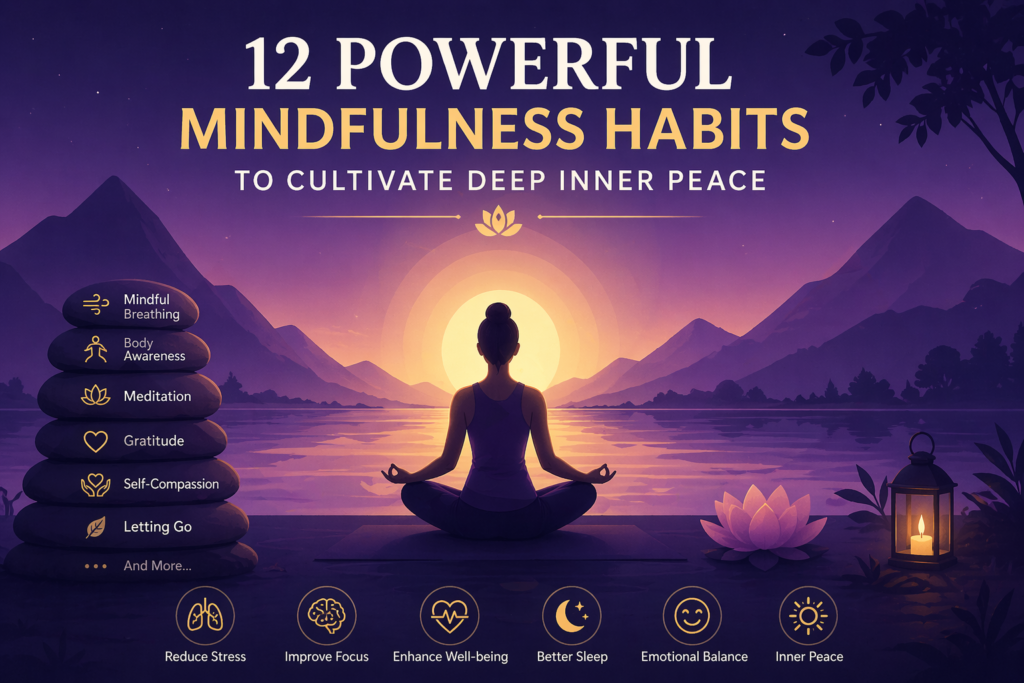
In a world that moves faster than our thoughts can settle, inner peace has become one of the most sought-after human experiences. We chase it through vacations, possessions, and productivity hacks — yet it continues to feel just out of reach. What if the path to deep, lasting peace was not found outside of you, but within? That is the promise of mindfulness, and the science and ancient wisdom of yoga are both firmly backing it up.
A landmark 2024 systematic review published in Biomedicines confirmed that mindfulness and meditation induce measurable neuroplasticity, increase cortical thickness, reduce amygdala reactivity, and improve brain connectivity and neurotransmitter levels, leading to improved emotional regulation, cognitive function, and stress resilience. In other words, the brain physically changes when you practice mindfulness consistently. Peace is not just a feeling — it is a neurological state you can train.
Here are 12 powerful mindfulness habits, rooted in both modern science and thousands of years of yogic tradition, that will help you cultivate the deep inner peace you deserve.
1. Breath Awareness Meditation (Pranayama)
The breath is the most immediate bridge between your body and your mind. In yoga, this practice is called pranayama — the regulation of life force through breath. The ancient yogis understood something that neuroscience is only now catching up to: controlling the breath directly changes the state of your nervous system.
Research published in 2024 in Frontiers in Psychology found that breath awareness was the most consistently preferred mindfulness practice among participants across an 8-week Mindfulness-Based Stress Reduction (MBSR) program, and that directing attention to breath sensations anchored people in the present moment and fostered inner peace. Deep breathing calms the nervous system, slows the heart rate, and reduces anxiety.
How to practice: Sit comfortably, close your eyes, and simply observe your natural breath for 5–10 minutes. Notice the sensation at the nostrils, the rise and fall of the chest, and the pause between inhale and exhale. When the mind wanders, gently return. Start here — everything else flows from this.
2. Body Scan Meditation
The body scan is a practice of deliberately moving your awareness through different parts of the body, noticing sensations without judgment. It is one of the core practices of Jon Kabat-Zinn’s MBSR program, developed in the late 1970s and now one of the most clinically validated mindfulness interventions in the world.
Neuroscientists at the Cognitive Neuroscience Society (CNS) 2024 meeting highlighted that tuning into interoception — the body’s internal sensing system — is a critical component of mindfulness training that can help manage mood disorders like depression. When you scan the body with open, curious attention, you are training interoceptive awareness, which directly supports emotional regulation.
How to practice: Lie down on your back. Starting from the top of your head, slowly move awareness downward — forehead, jaw, neck, shoulders, chest, belly, hands, hips, legs, feet. Spend 2–3 breaths at each area. Notice without trying to change anything. This practice is especially powerful before sleep.

3. Morning Sitting Meditation
Beginning your day in stillness sets a tone that can last for hours. Morning meditation is among the oldest spiritual practices across every tradition — from the yogic practice of Brahma Muhurta (the auspicious hour before sunrise) to Buddhist dawn meditation to Christian contemplative prayer.
A 2025 study in Frontiers in Psychology found that a mindfulness meditation program of 12 weekly sessions significantly improved stress, anxiety, depression, sleep quality, and life satisfaction among participants. Establishing a morning practice as a non-negotiable daily habit compounds these benefits over weeks, months, and years.
How to practice: Set your alarm 15–20 minutes earlier. Sit upright in a comfortable position before checking your phone. Focus on the breath, a mantra, or simply open awareness. Even 10 minutes consistently outperforms 60 minutes occasionally.
4. Mindful Yoga Asana Practice
Yoga’s physical postures are often misunderstood as mere exercise. In truth, traditional yoga asanas are meditative in nature. Performing them slowly, with discipline and awareness of the body’s state, breath, and mind, transforms movement into meditation. As the Yoga Institute notes, asanas inculcate the art of stillness — it is not about how long you hold a posture, but about the serenity and quietude generated during that time.
A 2022 review confirmed that mindful yoga used in therapeutic settings has several benefits that support mental health and alleviate stress — and importantly, traditional yoga is inherently mindful: the two are not separate disciplines but one unified path.
How to practice: Choose 4–6 postures daily — forward folds, hip openers, gentle twists, and restorative poses like Child’s Pose (Balasana) and Legs Up the Wall (Viparita Karani). Move slowly. Breathe intentionally. Treat every posture as a moving meditation.
5. Loving-Kindness Meditation (Metta)
Loving-kindness meditation, or Metta Bhavana in the Pali tradition, involves silently directing warm wishes and compassion toward yourself and others — first to yourself, then to loved ones, then to neutral people, and finally to difficult people or all beings everywhere.
Advanced brain imaging studies have shown that mindfulness practitioners increase inter-brain synchrony during interactions — an indicator of mutual understanding and connection. Metta meditation takes this further by deliberately cultivating the emotional states of warmth, goodwill, and compassion, which are strongly linked to life satisfaction and reduced social anxiety.
Neuroscience research also shows that mindfulness can increase empathy, emotional regulation, and interpersonal effectiveness — all outcomes that loving-kindness meditation directly trains.
How to practice: Sit quietly and repeat inwardly: “May I be happy. May I be healthy. May I be safe. May I live with ease.” After a few minutes, extend these same wishes to a loved one, then a neutral person, then a difficult person, and finally all beings. Practice for 10–15 minutes.
Also read: Men’s Mental Health Crisis
6. Mindful Walking
You do not need a meditation cushion to be mindful. Walking meditation transforms one of the most automatic daily activities into a powerful practice of presence. The Buddha himself taught walking meditation as equal in value to sitting practice.
Mindful walking grounds you in the body and the sensory world. You feel the feet touching the earth, the movement of the legs, the air on the skin, and the sounds around you. This kind of sensory attunement is exactly what neuroscientists mean by interoceptive and exteroceptive awareness — both are linked to better mental health outcomes.
How to practice: Find a quiet stretch of 10–15 feet indoors or outdoors. Walk slowly and deliberately. Notice the lifting, moving, and placing of each foot. When the mind wanders, return to the sensation of walking. Even 10 minutes a day deepens mindfulness substantially.

7. Gratitude Journaling
Gratitude is not just a feel-good concept — it is a mindfulness practice that rewires the brain’s negativity bias. The mind naturally scans for threats and problems; gratitude journaling deliberately redirects that attention toward what is already good, whole, and present in your life.
Research consistently shows that gratitude practices enhance life satisfaction and social support, while also reducing symptoms of depression and anxiety. In yoga philosophy, this connects to the niyama of Santosha — contentment — which is considered one of the essential inner disciplines for cultivating peace.
How to practice: Each morning or evening, write 3–5 specific things you are genuinely grateful for. Specificity matters more than quantity. Instead of “I am grateful for my family,” write: “I am grateful for the way my friend listened to me today without judgment.” This trains the mind to notice goodness in the present moment.
8. Digital Detox and Mindful Tech Use
One of the greatest threats to inner peace in modern life is the relentless flood of digital information. The average person checks their phone over 90 times per day, fragmenting attention and keeping the nervous system in a constant low-grade state of alertness.
Research from Carnegie Mellon University found that even short, regular use of mindfulness apps — as little as 10 to 21 minutes three times per week — produces measurable improvements in mental health. But beyond apps, intentional boundaries around technology use are themselves a mindfulness practice. Creating phone-free times, especially in the morning and before sleep, protects the mental space in which inner peace can grow.
How to practice: Designate your first 30 minutes of the day as phone-free. Set a “screen curfew” 1 hour before bed. Use one day per week for significantly reduced digital engagement. Notice how your inner landscape changes.
9. Yogic Nidra (Yogic Sleep)
Yoga Nidra, often called “yogic sleep,” is a guided meditation practice done lying down that systematically relaxes the body and mind while maintaining a thread of conscious awareness. It is one of the most powerful tools for stress recovery and inner peace in the entire yogic tradition.
Groundbreaking new research published in the Proceedings of the National Academy of Sciences found that focused-attention meditation stimulates the brain’s cerebrospinal fluid (CSF) circulation like sleep — efficiently clearing metabolic waste products linked to neurodegenerative diseases. Yoga Nidra, practised in a state between wakefulness and sleep, may offer similar restorative neurological benefits.
How to practice: Use a guided Yoga Nidra recording of 20–45 minutes. Lie in Savasana (corpse pose), eyes closed. Follow the teacher’s instructions through body rotation, breath awareness, visualisation, and rest. A single session is said to provide the rest equivalent of 2–4 hours of sleep.
Comparing the Habits
| Habit | Time Commitment | Evidence Strength | Primary Benefits |
| Meditation | 10–20 min daily | High (many RCTs) | Reduces stress, anxiety, depression; improves focus and well-being[5][3]. |
| Breathing Exercises | ~5 min, 2–3 times/day | High (meta-analyses) | Lowers heart rate/BP, increases parasympathetic tone[6]; instant calm. |
| Body Scan | 10–20 min, daily/evening | Moderate (MBSR-based) | Relaxes muscles, reduces tension; improves sleep and anxiety. |
| Yoga/Stretching | 15–60 min, 2–5×/week | High (systematic reviews) | Lowers stress/anxiety, increases flexibility and mood[10]. |
| Walking Meditation | 10–15 min, daily | Moderate | Combines exercise + mindfulness; reduces anxiety[7], boosts mood. |
| Forest Bathing | 30–60 min, weekly | Moderate (meta-analysis) | Significantly lowers cortisol[2]; improves mood, immune function. |
| Loving-Kindness | 5–15 min daily | Moderate | Increases positive emotions and empathy[13][21]; reduces negativity. |
| Gratitude Journaling | 5–10 min, ≥3×/week | Moderate | Boosts happiness and sleep quality[17][18]; lowers stress. |
| Mindful Eating | 1 meal/day (15–30 min) | Moderate | Helps control binge/emotional eating; promotes healthier habits[19]. |
| Mindful Listening | Ongoing, daily | Emerging | Enhances relationships and empathy; may reduce interpersonal stress[21]. |
| Mindful Pauses | 2–3 min, several/day | Moderate | Quick resets of calm; improves focus and stress management[20]. |
| Sleep Wind-Down | 5–10 min nightly | Moderate | Improves sleep quality; reduces bedtime anxiety (via relaxation)[18]. |
Also read: Nofap Benefits Myth or Reality studies
10. Mindful Eating
We eat multiple times a day, yet we are rarely fully present for it. Mindful eating means engaging all the senses during meals — noticing flavours, textures, aromas, and colours, and eating slowly, without screens or distractions. In yogic philosophy, eating mindfully honours the principle of Ahimsa (non-harm) and Saucha (purity), treating food as a sacred nourishment of body, mind, and spirit.
Mindfulness-based interventions have been shown to improve self-regulation in executive function-related areas of the brain, such as the prefrontal cortex — the same region responsible for impulse control in eating behaviours. Mindful eating reduces stress-related eating, improves digestion, and builds a more peaceful relationship with the body.
How to practice: At least once a day, eat a meal without your phone or TV. Take three deep breaths before your first bite. Chew slowly and thoroughly. Put down your fork between bites. Notice when you feel satisfied rather than full.
Also read: Mediterranean Diet Weight Loss Plan
11. Evening Reflection and Self-Inquiry
Ancient yogic texts emphasise Svadhyaya — self-study or self-inquiry — as one of the most transformative practices on the path to inner peace. An evening reflection practice creates a conscious bookend to your day, helping you process emotions, acknowledge growth, and release what no longer serves you before sleep.
This practice is also supported by modern psychology. Journaling about thoughts and feelings has been shown to provide insights that enrich mindfulness practice, document growth, and serve as a source of encouragement along the inner journey. Naming and examining emotions reduces their charge — a process neuroscientists call “affect labelling.”
How to practice: Spend 5–10 minutes before bed writing or reflecting on: What went well today? Where did I lose my peace, and why? What am I learning about myself? What am I releasing before sleep? Over time, this builds profound self-awareness and emotional intelligence.
12. Consistent Community and Guided Practice (Satsang)
The final, often-overlooked habit is the power of community. In yogic tradition, Satsang — gathering with others who share a sincere aspiration toward truth and peace — is considered one of the most accelerating forces on the spiritual path. You cannot reach your highest potential in isolation.
Modern research echoes this ancient wisdom. Studies show that mindfulness training increases inter-brain synchrony during social interactions — meaning the quality of our attention affects the quality of our connections. Practising in a community, whether a yoga studio, meditation group, or online circle, provides accountability, inspiration, and the subtle support of collective energy.
How to practice: Commit to one weekly class, group meditation session, or online mindfulness community. Supplement with guided recordings from teachers you trust. The combination of consistent solo practice and community reinforcement is far more powerful than either alone.
The Science Speaks and So Does 5,000 Years of Yoga
What is remarkable about this moment in history is that modern neuroscience and ancient yogic wisdom are arriving at the same conclusion from different directions. Science tells us that mindfulness induces neuroplasticity, reduces cortical amygdala reactivity, improves prefrontal cortex function, lowers stress biomarkers, and may even slow cellular ageing. Yoga tells us that through consistent practice of body, breath, and awareness, we move from the restless surface of the mind into the deep stillness that is our true nature.
These 12 habits are not a checklist to complete. They are an invitation. Start with one. Practice it sincerely for two weeks. Then add another. Inner peace is not a destination you arrive at — it is a quality you cultivate, moment by moment, breath by breath, day by day.
The peace you are looking for is already inside you. These practices help you remember where to look.
How do I increase my inner peace?
To increase inner peace, start with small daily mindfulness habits like meditation, deep breathing, and gratitude journaling. Reducing distractions, especially digital overload, and spending time in nature also helps calm the mind and build long-term emotional balance.
How do I make peace with my inner self?
Making peace with your inner self requires self-awareness and acceptance. Practice self-reflection, observe your thoughts without judgment, and treat yourself with kindness. Letting go of past regrets and focusing on the present moment is key.
How to find inner peace when everything is falling apart?
When life feels overwhelming, focus on what you can control—your breath, your thoughts, and your actions. Ground yourself through deep breathing, mindfulness, and small routines. Inner peace comes from stability within, not external situations.
How do I create inner peace?
Inner peace is created through consistent habits like meditation, mindful living, emotional awareness, and self-care. It’s not a one-time achievement but a daily practice of choosing calm over chaos.
How to get peace of mind in daily life?
You can achieve peace of mind by simplifying your routine, practicing mindfulness, limiting stress triggers, and maintaining a healthy work-life balance. Even 10 minutes of meditation daily can make a big difference.
What are the best mindfulness habits for beginners?
Beginners can start with simple practices like breath awareness, mindful walking, gratitude journaling, and short guided meditations. These habits are easy to follow and highly effective in reducing stress.
How long does it take to feel the benefits of mindfulness?
Many people start feeling calmer within a few days of consistent practice. However, deeper changes like improved emotional control and mental clarity typically develop over weeks or months.
Can mindfulness really reduce stress and anxiety?
Yes, scientific research shows that mindfulness reduces stress, lowers anxiety levels, and improves emotional regulation by calming the nervous system and enhancing brain function.
Is yoga necessary for inner peace?
Yoga is not mandatory, but it can greatly support inner peace by combining movement, breath, and awareness. Even simple stretching with mindful breathing can be beneficial.
Can I practice mindfulness without meditation?
Absolutely. Mindfulness can be practiced in daily activities like eating, walking, listening, or even working. The key is to stay fully present and aware in whatever you are doing.

Abhishek Negi is the founder and content creator behind Peak Mode Life. He writes about fitness, nutrition, wellness, relationships, and healthy living. His goal is to simplify health information into practical, actionable advice that helps readers build sustainable habits and improve their overall quality of life.