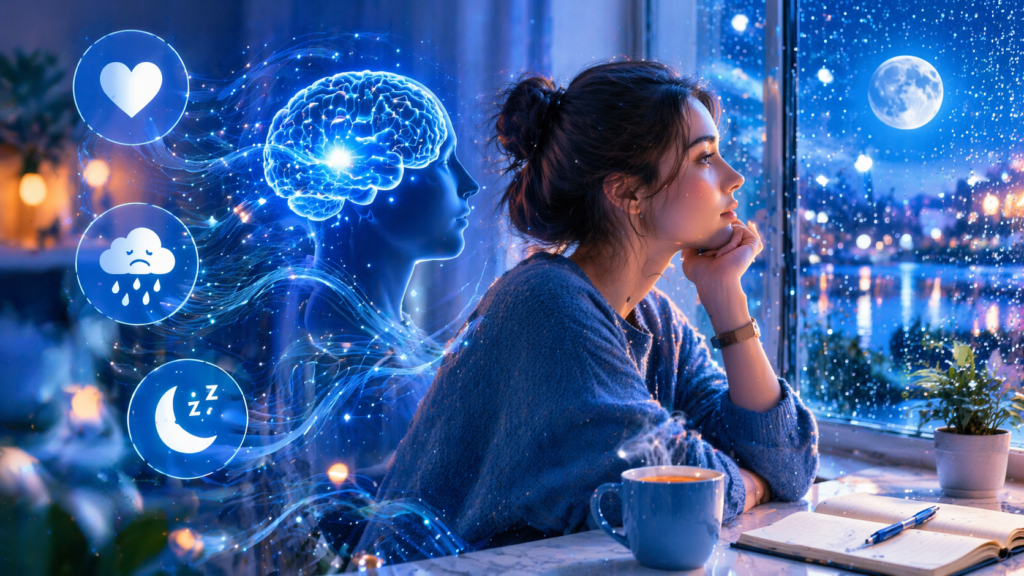
The world’s most beloved colour is hiding a fascinating psychological complexity, and why blue affects your emotions reveals that it has more power over your mind and body than you might think.
Close your eyes for a moment and picture the colour blue. Maybe you see a clear afternoon sky, or the deep, still surface of the ocean, or the soft glow of early morning before sunrise fully arrives. Whatever image came to mind, there is a good chance it carried a feeling with it, calm, perhaps, or a quiet sense of peace. Maybe, just maybe, a slight tinge of melancholy.
That is the paradox of blue. It is, by almost every global measure, the world’s favourite colour. And yet it is the colour we reach for when we want to describe sadness — “feeling blue,” “singing the blues,” “a blue Monday.” It slows your heart and health. It sends you to sleep. It makes you trust a stranger. And in the wrong shade, at the wrong moment, it can make a room feel cold and isolating.
So what is actually going on? Why does a single colour carry so many contradictory emotional signatures? The answer lies in a combination of biology, culture, psychology, and thousands of years of human experience. Let us take a proper look.
The World’s Favourite Colour: Why Blue Affects Your Emotions
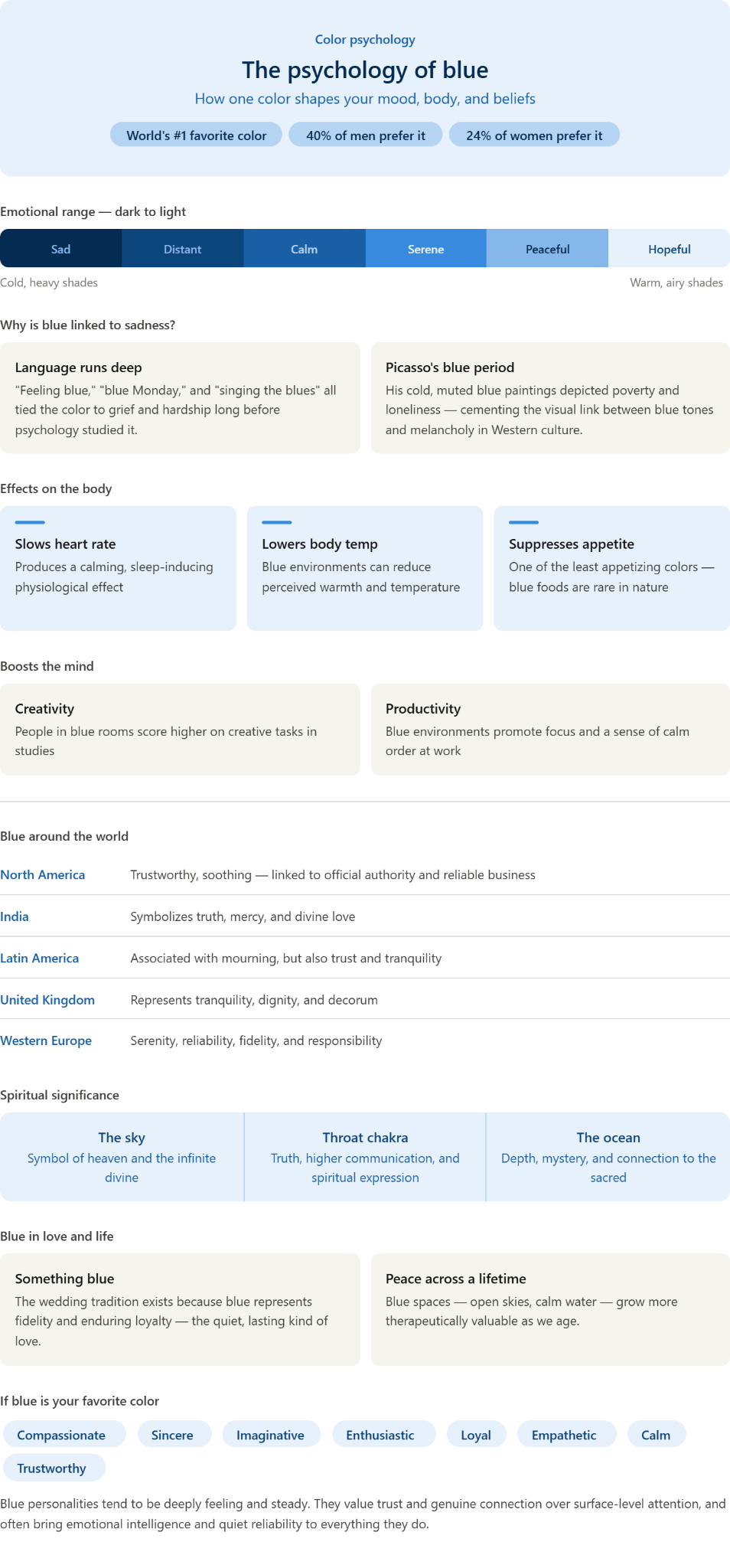
Before we get into the how and why, it is worth appreciating just how universally blue is loved. A survey conducted across 10 countries found blue to be the most popular favourite colour on earth. In the United States alone, 40% of men and 24% of women name blue as their top pick. No other color comes close to that kind of cross-cultural, cross-demographic appeal.
That kind of widespread preference is not an accident. It points to something deep — something that goes beyond personal taste or passing trends. Blue, it turns out, is woven into the very fabric of human experience. It is the color of open sky, of clean water, of clear weather. For most of human history, an expanse of blue above you meant safety. No storm. No fire. No predator hiding in the dark. Blue meant the world was, at least for now, okay.
That ancient, instinctive sense of safety has never really left us. It just moved indoors.
How Blue Makes You Feel Safe
Walk into almost any bank, hospital, law enforcement office, or government building in the Western world, and you will encounter blue. This is not a coincidence. Blue has become the visual shorthand for trustworthiness, authority, and reliability, and businesses know it.
People consistently associate blue with stability and order. It reads as conservative and non-threatening. It does not demand attention or excitement the way red does. It does not suggest risk. Instead, it communicates something quieter and more reassuring: we are solid, we are dependable, we have been here before, and we will be here again.
This is exactly why law enforcement agencies across America chose blue uniforms. The darker the shade, the more authoritative the impression. Deep navy blue signals seriousness, discipline, and control — without the aggression that a stark black uniform might project. It says “trusted authority” rather than “threat.”
The same principle applies in the digital world. Look at the logos of Facebook, LinkedIn, PayPal, Samsung, Ford, and American Express. All blue. These are companies asking you to hand over your personal information, your financial data, your professional identity — and blue is quietly doing the work of saying: you can trust us.
In relationships and personal life, blue carries similar weight. In many Western traditions, a bride wears “something blue” on her wedding day — a custom rooted in the colour’s longstanding association with fidelity, loyalty, and constancy. Blue does not waver. Blue does not betray. Blue, symbolically speaking, stays.
The Science Behind Blue’s Calming Effect
The emotional experience of feeling safe around blue is not purely psychological. There is measurable physiology happening beneath the surface.
Research has found that exposure to the color blue can actually reduce a person’s heart rate. Think about that — a color, acting almost like a mild sedative, slowing the rhythm of your heart. It can also lower body temperature. This is part of why blue-painted rooms have historically been associated with rest, recovery, and contemplation.
In offices, studies have found that people working in blue environments tend to be more productive and more creative. The calming effect of blue, rather than making people sluggish, appears to create the kind of mental clarity and quiet focus that allows for deeper thinking. It removes the noise without removing the energy.
This is why blue is such a common choice in bedrooms and meditation spaces. It is not simply aesthetic. The color is doing physiological work — gently nudging the nervous system toward a calmer state, making it easier to slow down, breathe deeply, and rest.
Which brings us to sleep.
Why Blue Makes You Sleepy
This is where blue’s calming properties tip into something a little more literal. Because blue does not just relax the mind — in the right context, it actively promotes sleepiness.
The lowered heart rate, the reduced body temperature, the quieting of mental chatter — all of these are exactly what the body needs to transition from wakefulness into rest. Blue, especially in soft or muted tones, mimics the quality of late-day or early-morning light, the hours bookending sleep.
There is an irony worth noting here. The very wavelength of light that our screens emit — that harsh, artificial blue light from phones and laptops — actually does the opposite. It tricks the brain into thinking it is daytime, suppressing melatonin production and making sleep harder to achieve. This is the same color that, in a softer, more natural form, would have helped our ancestors settle down as the sky deepened at dusk.
The lesson is that it is not just the color itself, but the quality and intensity of the light. Soft, desaturated blue is deeply restful. Bright, high-frequency blue light is a stimulant. Context matters enormously.
For decorating purposes, this means that pale blue walls, soft blue linens, and muted blue tones in a bedroom create a genuinely sleep-supportive environment — not just a pretty one. Your body is responding to those visual cues in real, measurable ways.
The Blue Paradox: Why It Also Makes You Sad
And now for the shadow side.
“Feeling blue.” “Singing the blues.” “A case of the Mondays… blue Monday.” In the English language, blue has been synonymous with sadness and depression for centuries. Picasso famously went through his “Blue Period” — a stretch of work painted almost entirely in cold blues and blue-greens — during one of the most emotionally painful periods of his life. The paintings feel lonely. Still. Heavy with something unspoken.
Why does the world’s favorite color also become the visual language of grief?
Part of the answer is that blue’s calming qualities can, taken too far or in the wrong light, become isolating. A color that quiets, that cools, that creates distance — in the wrong emotional context, that same quality reads as coldness. Detachment. Absence.
Think of the difference between a warm, blue summer sky and a flat, grey-blue winter afternoon. The same color family, but one feels expansive and free while the other feels oppressive and closed. Lighting, saturation, and temperature all shift the emotional register of blue dramatically.
Blue’s association with the spiritual — with the vast sky, with deep water, with spaces that dwarf the individual — can also produce a particular kind of awe that tips into longing or melancholy. Standing at the edge of the ocean and staring into that blue expanse is one of the most reliably moving experiences a human being can have. But it does not always make you feel happy. Sometimes it makes you feel small. Sometimes it makes you grieve for something you cannot quite name.
This emotional complexity is part of what makes blue such a rich artistic color. It carries depth. It allows ambiguity. A painting dominated by blue can hold sadness and serenity simultaneously in a way that red or yellow simply cannot.
Blue Across Cultures: The Meaning Is Not Universal
If you assumed everyone experiences blue the same way, it is worth pausing. Cultural context shapes the emotional meaning of color in profound ways, and blue is no exception.
In North America, blue is soothing — linked to trustworthy institutions and calm authority. In the United Kingdom, it suggests tranquility, dignity, and decorum. In Western European countries, blue carries associations with truth, serenity, and fidelity.
In India, blue takes on a sacred quality — it is the color of Krishna, symbolising truth, mercy, and divine love. In Latin America, the picture is more complex: blue is associated with mourning and loss, but also with trust and tranquillity. These are not contradictions so much as different facets of the same color, seen through different cultural lenses.
What this tells us is that while some of blue’s psychological effects appear to be near-universal — likely rooted in our shared evolutionary experience of sky and water — others are culturally constructed. The emotion blue triggers in you is partly a product of where and how you grew up, and what you were taught, consciously or not, to associate with it.
Also read: 10 Effective Ways to Clear Brain Fog Fast
Blue in Spiritual Life
Across many traditions, blue occupies a uniquely sacred space. The sky has always functioned as humanity’s first and most accessible metaphor for the divine — something vast, unreachable, and above. Blue, as the color of that sky, absorbed some of that sacred quality.
In chakra traditions, blue governs the throat chakra — the energy center associated with communication, truth, and higher spiritual expression. People who work with this chakra framework often associate blue with clarity of voice, authenticity, and a connection to something beyond the ordinary.
The deep blue of ocean water carries its own spiritual weight for many people. There is a reason humans have always felt drawn to the sea — something about its depth, its rhythm, and its blue-grey immensity meets a need in us that is hard to articulate but immediately recognizable.
Blue and the Body: A Color That Affects More Than Your Mood
It is easy to think of color psychology as being entirely about emotions and symbolism — interesting, but soft. The reality is that blue appears to have measurable physical effects.
Beyond heart rate and body temperature, blue has been observed to suppress appetite. This is why blue is considered one of the least appetising colours, and why some weight-loss approaches suggest using blue plates. In nature, blue food is rare, and when it does appear, it often signals something has gone wrong. Mold. Spoilage. Poison. Our instincts, still calibrated for a world where blue food and diet meant danger, make blue an ineffective colour for stimulating hunger.
This is also why you will rarely see a fast-food restaurant decorated in blue. The colours of appetite, red, orange, and yellow, are precisely the opposite of blue. They stimulate, they excite, they signal warmth. Blue does none of these things. It is not trying to energise you. It is trying to help you slow down.
Must read: 30-Day Mediterranean Diet Meal Plan for Weight Loss
How Blue Affects You Personally
Here is the part that matters most: your own relationship with blue is unique to you.
General patterns are real. Blue does tend to calm people. It does reduce heart rate. It does signal trust across many cultures. But individual experience shapes these responses in meaningful ways. If the color blue is strongly associated in your memory with a specific person, a place, a moment — positive or negative — that association colors (quite literally) how you experience it emotionally.
Someone who grew up near the ocean might find deep navy instantly comforting. Someone who associates blue with a cold, sterile hospital room might find it unsettling. Someone who spent years painting in a blue-lit studio might associate it with creative joy rather than rest.
This is why color psychology, while offering real and useful insights, should never be treated as a fixed formula. You are not simply a subject being acted upon by wavelengths of light. You bring your whole life to the way you see color.
The Takeaway
Blue is not a simple colour. It is the color that slows your heart and earns your trust. It is the color of the sky that promised ancient humans the storm had passed. The fact that a color can do all of this is, if you think about it, remarkable. Blue is not just a visual experience; that’s why blue affects your emotions.
Next time you are drawn to wear blue, or paint a room blue, or linger in front of a blue painting longer than you planned to, you might ask yourself: What is it doing for me right now? Is it calming me? Grounding me? Or is it speaking to something quieter and harder to name?
Whatever the answer, you are in good company. The whole world loves blue. We just love it for very different reasons.
Why is blue linked to sadness?
The connection runs deep through language and art. Phrases like “feeling blue,” “blue Monday,” and “the blues” in music all reinforce the association. Picasso’s famous “Blue Period” paintings — filled with cold, muted tones — depicted loneliness and hardship, cementing the visual link between blue and melancholy. As a cool color, blue can feel distant and icy, which our minds interpret as emotional withdrawal or sorrow.
Is blue a grieving color?
It depends on the culture. In Latin America, blue is directly associated with mourning. In Western cultures, black is the traditional colour of grief, but blue carries a quiet, sombre quality that makes it adjacent to grief — think of the stillness of a grey-blue sky or deep water. It’s less about death and more about longing and emotional heaviness.
Is blue a sad or happy color?
Both, depending on context. Blue is one of the most emotionally complex colors — it can feel peaceful and uplifting (a clear blue sky, a calm ocean) or melancholic and withdrawn (cold blue tones, overcast light). The shade matters a lot: bright sky blue reads as cheerful and open, while deep navy or dull greyish-blue reads as sombre. Your personal experiences with the color also shape how it lands emotionally.
Why does blue make me calm?
Research shows that blue actually triggers physiological changes — it can slow your heart rate and lower your body temperature, producing what scientists describe as a “sleepy effect.” This is likely because we evolved surrounded by blue skies and water, environments that signal safety and stillness. That’s why studies show people are more productive and creative in blue rooms, and why blue is so popular in office design.
What does Blue mean in love?
In love and relationships, blue symbolises fidelity, loyalty, and steadiness. This is why the Western wedding tradition of wearing “something blue” exists — it represents a faithful, enduring commitment. Blue love isn’t passionate or fiery; it’s the quiet, dependable kind — the love that stays.
If your favourite colour is blue, what does that say about your personality?
People with blue as their favourite colour tend to be compassionate, sincere, imaginative, and enthusiastic. They’re often described as empathetic and thoughtful, with a strong sense of loyalty. The “blue personality” leans toward calm, reflective, and emotionally intelligent — someone who values trust and deep connection over surface-level excitement.
What is blue’s meaning in emotion?
Blue covers a wide emotional spectrum. On the positive end: calm, peace, tranquillity, security, trust, and clarity. On the cooler end: sadness, distance, aloofness, and melancholy. It’s rare for a single color to hold such emotional range, which is part of why blue resonates so universally — it mirrors the full depth of human feeling.
What does blue mean spiritually?
Blue carries rich spiritual significance across many traditions. It’s the colour of the sky and ocean — both vast, boundless, and often associated with the divine or the infinite. In chakra practice, blue represents the throat chakra, which governs communication, truth, and higher spiritual expression. It’s seen as a colour of heaven, healing, and transcendence. Many spiritual traditions view blue as a bridge between the earthly and the sacred — a colour that opens the mind upward.

Abhishek Negi is the founder and content creator behind Peak Mode Life. He writes about fitness, nutrition, wellness, relationships, and healthy living. His goal is to simplify health information into practical, actionable advice that helps readers build sustainable habits and improve their overall quality of life.